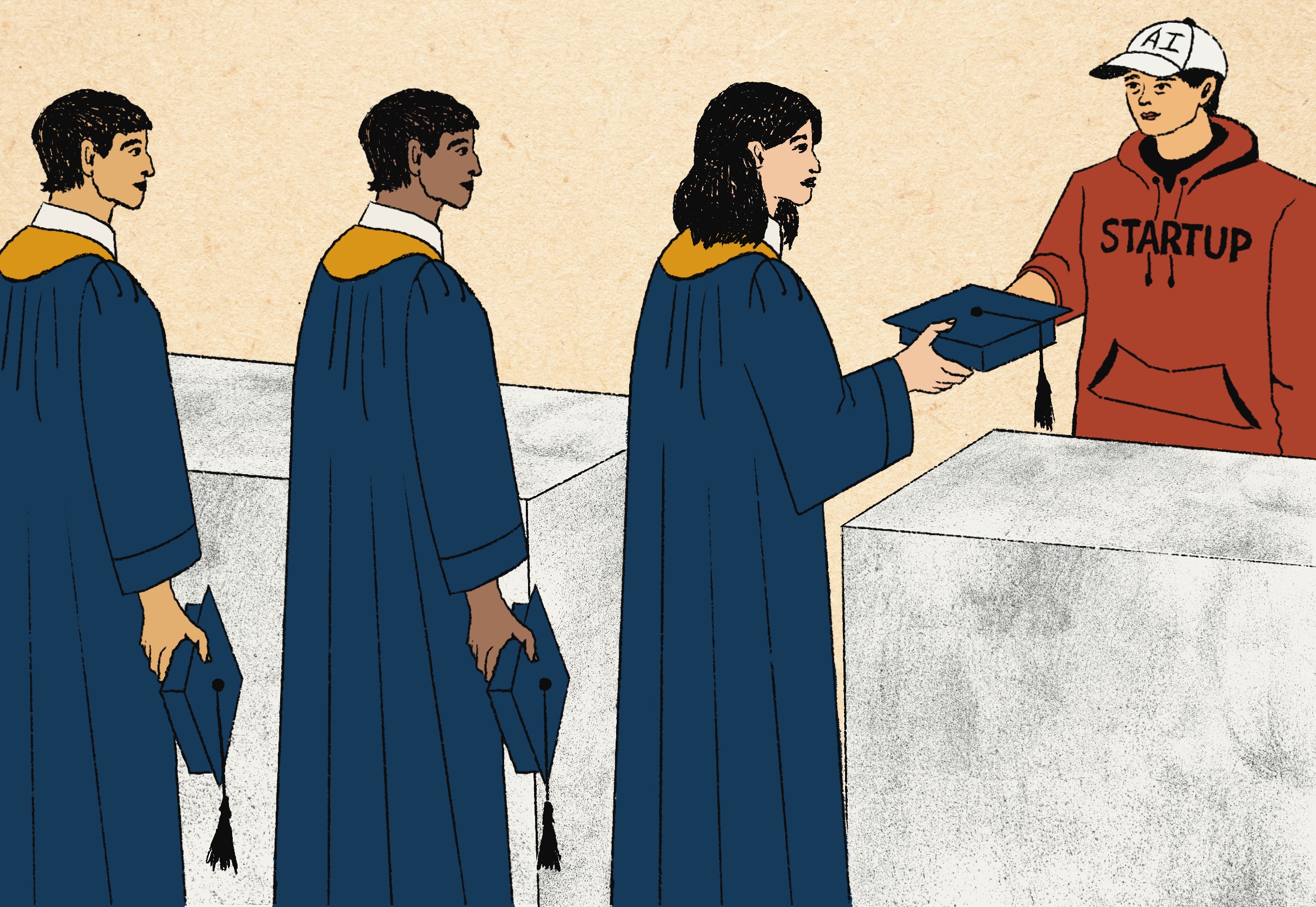
“I’m a genius,” Alex Forman wrote in a viral post on X, announcing the launch of his AI-powered web-scraping tool Parse. Less than a month later, with enough funds to pay his own salary for a year, he left UC Berkeley.
Forman is not alone.
“I dropped out of Berkeley … to kill Tinder with AI,” former campus student Allen Wang posted to promote his Google-backed AI dating app. Since Wang dropped out, Ditto has expanded to four campuses, amassed more than 40,000 users and hosted an infamous yacht party to match up UC Berkeley students.
Wang was “inspired” to drop out by his friends, who he characterized as fellow entrepreneurs. “A lot of my friends … decided to drop out, so it makes me feel like it’s not that weird to drop out and pursue your own path,” he said.
For former campus student Rushil Agarwal, the founder of Human Archive, a multimodal data provider for robotics training, dropping out was on the horizon as soon he started building.
His co-founders decided to skip their finals and drop out of UC Berkeley in December 2025. Shortly afterward, they joined the most recent batch of startups funded by Y Combinator, an investor that helped launch Reddit, Airbnb and others. Agarwal plans to leave UC Berkeley this spring. These days, he’d choose building or attending a venture capital networking event over going to lecture, saying he wants to “capitalize on” what he’s learning outside of school.
Dropping out was barely in college students’ lexicon a decade ago, but now it’s a badge of ambition — a means to to stand out, something that isn’t easy among UC Berkeley’s throngs of computer science graduates.
One in six of the companies accepted to Y Combinator’s fall 2025 batch was founded by a college dropout, and more founders came from UC Berkeley than from any other university.
Incubators such as Y Combinator and Founders, Inc. — which provided Forman with early support — supply resources and space for would-be founders to develop products in the hopes of receiving investment. Founders, Inc. puts perhaps too fine a point on the mission in its call to “build instead of study.”
Such companies also help founders create a marketable persona. Forman didn’t write his viral post himself; his colleagues at Founders, Inc. crafted it as “rage bait.”
It’s no coincidence that many founders position themselves and the dropout mythology at the center of their brand. Marketability is key to success in this space, and dropping out has become a clear signifier of unbridled motivation.
“A degree is always helpful to fall back on, but when you’re building, the mindset is never to have a backup option or plan B,” Agarwal said. “Otherwise you won’t have enough of a risk appetite or enough ability to go all-in on anything.”
Ultimately, such founders are dropping out for an audience. Founders are performing for VCs — investors such as those at Menlo Park-based Sequoia Capital who are looking for “the outsiders,” “the defiant” and “the independent thinkers.” These are the “geniuses” that Forman’s tweet alluded to. Yet his own experience has been more sober.
“You kind of have to have the delusion that you, (a) random person, without really any real experience in life and way less money than any big company, will win in some sector or market competitively,” he said. “You’re playing in a game where outliers win — and it’s inherently a game of outliers.”
As more traditional career paths are upended and the postgrad unemployment rate for computer science majors rises, some companies have looked to capitalize by openly degrading public education.
The Thiel Fellowship — created by the Silicon Valley billionaire and co-founder of PayPal, Peter Thiel — and Palantir’s Meritocracy Fellowship offer even younger high school graduates and college students “with the highest aptitude” hundreds of thousands of dollars to “skip the indoctrination” of college and become the ideal founder.
The Thiel Fellowship website states, “College can be good for learning about what’s been done before, but it can also discourage you from doing something new.” Palantir asserts that “American universities have lost their way.” The program advertises itself as seeking high-achieving individuals who “deserve challenges, not a set curriculum” — taking the persona of the genius dropout to its logical extreme.
UC Berkeley, too, has embraced the entrepreneurial spirit.
The decision to appoint Rich Lyons — the former dean of campus’s Haas School of Business and campus’s first-ever Chief Innovation and Entrepreneurship Officer — as chancellor reflects an increasingly business-forward vision of UC Berkeley.
Lyons helped found Berkeley SkyDeck, campus’s own startup accelerator, and constantly touts UC Berkeley’s label as the No. 1 producer of venture-backed startups.
Education, it seems, is a means to an end — that end being entrepreneurship.
“Berkeley gives you the best first-hand experience into the sort of ecosystem that everyone talks about — the ecosystem of Silicon Valley,” Agarwal said. “As soon as you enter Berkeley as a freshman, you’re surrounded by founders.”