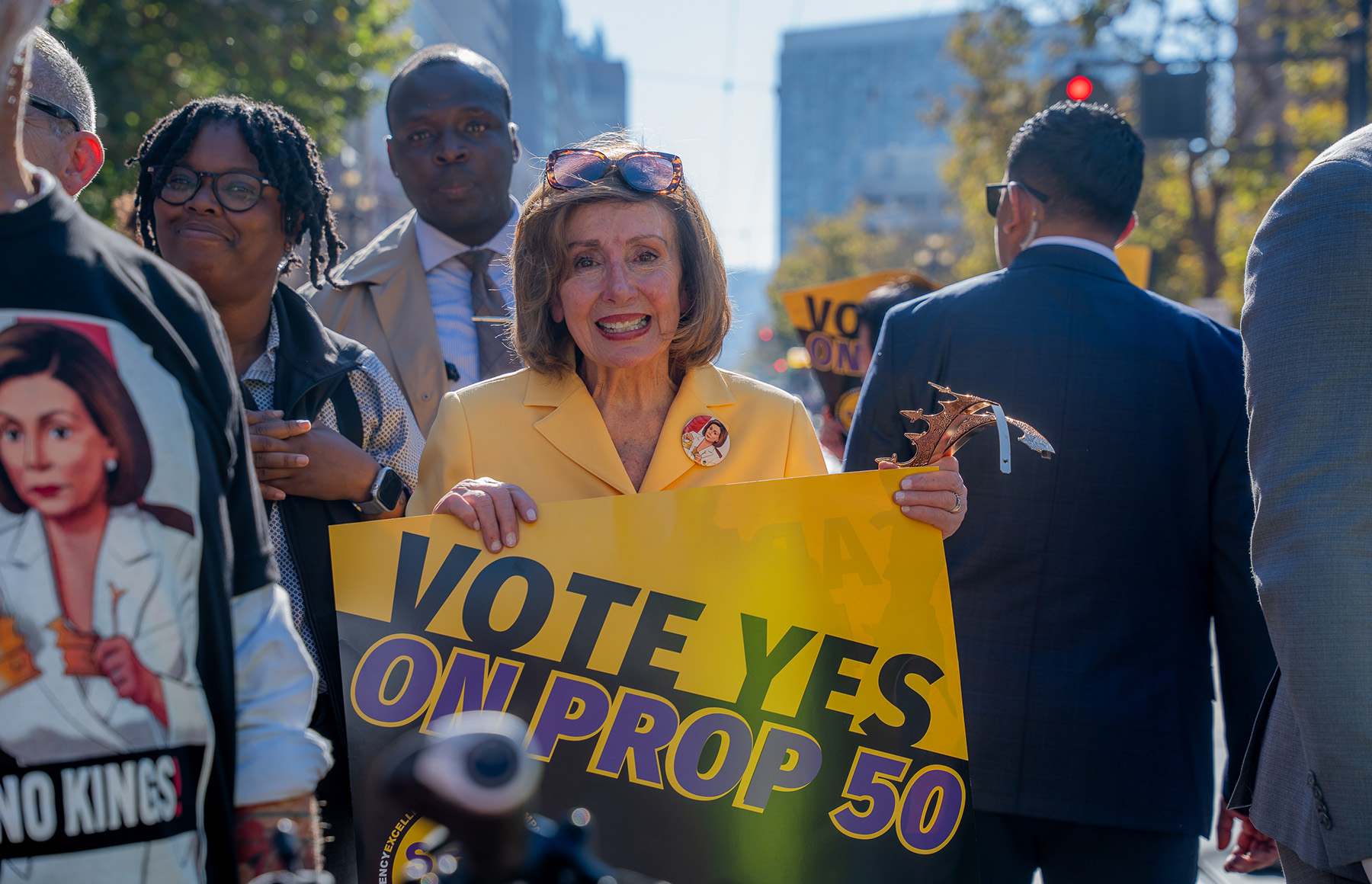
Of the deep-blue liberal districts of the West, one representative has risen from the fog-swept hills of San Francisco to polarizing national prominence. Nancy Pelosi, the 37-year Democratic incumbent from the Golden State, is possibly the most powerful woman in the nation’s history, serving as the first female Speaker of the House and a longtime leader of the Democratic Party.
While Pelosi’s importance to San Francisco’s political history has earned her recognition on street names and been embossed on city federal buildings, her role as gatekeeper to liberal political futures has seen the representative’s favor fall as progressive voters grew frustrated with their geriatric party leadership.
The 85-year-old currently serving her 20th term in the House felt the ire of a beat-down democratic base after the party took a shellacking in 2024 when Donald Trump won his second term as president, and the Republican Party found a majority in both houses of Congress.
Reflecting a fall from political dominance, both anti-establishment challengers and party insiders said they would challenge Pelosi for the lauded California District 11 seat before the congresswoman officially announced last November that she would not seek reelection in 2026.
Now, three democratic hopefuls are running to replace Pelosi in a district that has not seen real competition in nearly 40 years. A jungle primary will be held in June, and the two candidates who receive the most votes will face off in a November head-to-head.
As no public polling has been released on this once-in-a-generation race, I got the chance to interview each candidate, discussing key issues — the future of the Democratic Party, Trump, Israel, higher education and more, to identify who will be the leader of the post-Pelosi order.
Let’s meet our candidates
Long before Pelosi stepped aside, Saikat Chakrabarti stepped in. A relatively unknown progressive strategist who wrote the Green New Deal as chief of staff to Alexandria Ocasio-Cortez, Chakrabarti has the unique ability to self-fund his campaign. The “New Deal” Dem amassed a net worth of nearly $200 million, according to Business Insider, after striking it rich in tech.
As the 40-year-old Chakrabarti positioned himself as a youthful, outsider foil to Pelosi, gaining traction with viral clips in which he called for House Minority Leader Hakeem Jeffries to be primaried, longtime San Francisco politician Scott Wiener began to grow restless. An undeniably prolific legislator in the state senate, Wiener held himself as the natural successor to the city’s house seat, leading him to jump into the race two weeks before Pelosi stepped aside Nov. 6, 2025.
Giving two weeks of clemency to the former speaker’s historic career, union-backed San Francisco Supervisor Connie Chan rounded the candidate count out to three Nov. 20, 2025, when she posted a campaign announcement video referencing Pelosi and the continuation of her legacy.
The giant and the contenders
While a cursory glance at each candidate’s platform may not help the average voter differentiate between their options in the June election, one hopeful is likely a shoo-in to appear on the November ballot.
Scott Wiener is a powerful player in California politics, often seen towering behind Gov. Gavin Newsom as he signs many of the senator’s legislative victories into law. He has long been a leader in housing policy, authoring bills that forced California cities to tear down red tape that prevents development. These Yes In My Backyard, or YIMBY, politics have found Wiener allies within the nationwide “abundance agenda,” posing in an end-of-year Instagram photo dump with the movement’s avatar, Ezra Klein.
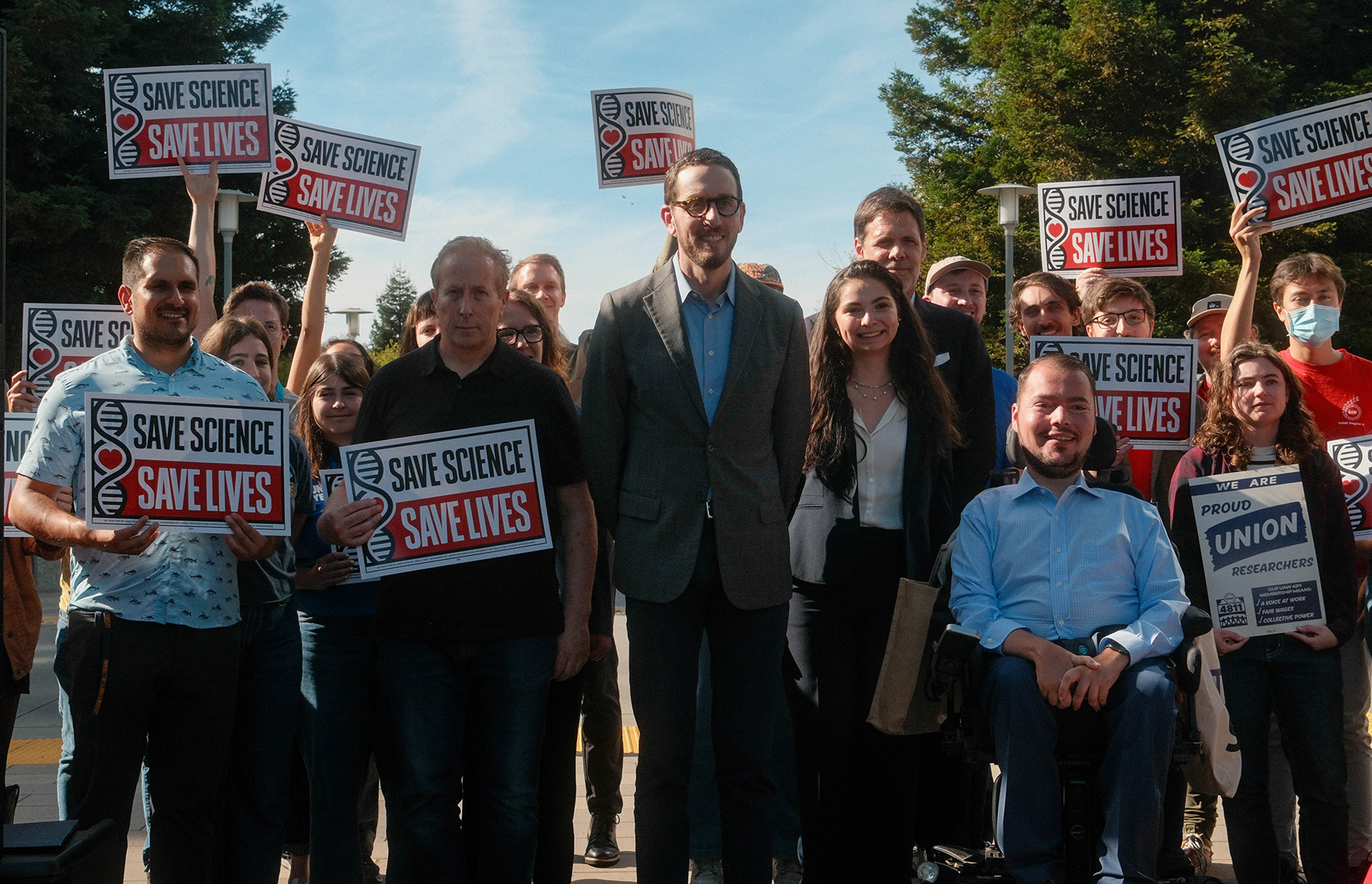
In a pre-endorsement vote ahead of the mid-February California Democratic Party’s 2026 State Convention in San Francisco, Wiener found some recognition for his years of behind-the-scenes politicking, gaining 77% of the vote. Behind him, Chan earned 33% of the vote while Chakrabarti, unsurprisingly, received zero.
An outspoken LGBTQ+ rights warrior and leader of the California Jewish Legislative Caucus, Wiener has faced criticism from both conservatives and progressives. Notably, his support for controversial legislation and his coziness with corporate interests have drawn scrutiny from some on the progressive left. For his LGBTQ+ advocacy and other work, the state senator has become an occasional Republican target, a point Wiener seems to cherish, flaunting the attacks on his website dubbed “Scott’s MAGA Fan Club.”
To punctuate Wiener’s advantage, his campaign represents the wants of an emboldened San Francisco “moderate” scene. While the definitions are not exact, San Francisco moderates employ an aggressive, often corporate-backed approach to housing with a business-friendly tax policy to boot. Candidates running on a more moderate platform, led by Mayor Daniel Lurie, delivered a marked victory over their “progressive” counterparts in the city’s 2024 election, signaling a shifting tide that could sweep Wiener into Washington.
Given Wiener’s deep ties to the city and state’s Democratic establishment, his campaign has outpaced both Chakrabarti and Chan in fundraising efforts. He started the race with a $1 million war chest funded by a congressional exploratory committee launched more than two years ago. The most recent Federal Election Commission filings, current until Dec. 31, 2025, reveal Wiener’s campaign has raised $2,785,939.
Chakrabarti, buoyed by personal loans totaling $1.47 million, finished 2025 second in fundraising with $1,769,247 while Chan lagged far behind at $174,385.
The Wiener Worries
The three candidates were set for the cycle’s first public face-off in a packed auditorium in early January during an election forum at UC Law.
With a stage set for a raucous night of minute political jockeying, the candidate forum was the place to be. Organizers touted 1,500 RSVPs for a space of several hundred seats, leading to onlookers packing overflow rooms and the online telecast crashing as the watch party climbed to more than a thousand participants.
Only six months out from the primary, the event represented a critical first impression for the contestants.
While each participant had their hiccups and gaffes during the debate, Wiener’s performance dominated the headlines after the candidates were tasked with raising posters claiming simple support or opposition to a series of questions.
In a now-infamous clip, moderators asked the candidates if they believe Israel has committed a genocide in Gaza.
Chakrabarti and Chan immediately raised their signs indicating “Yes,” while Wiener spun his sign indecisively between his knees as the crowd roared with boos and a few attendees berated the state senator.
“Shame on you, Scott!” one man yelled as moderators attempted to quell the noise.
Following the forum, Wiener initially claimed the question was too complex for a simple “yes or no” answer before releasing a video to social media a few days later, where he reversed course and said he did think Israel had committed a genocide in Gaza.
Despite Wiener’s newfound agreement with Chan and Chakrabarti, the move proved incendiary among his Jewish base and found little love on the pro-Palestinian left. The backlash from Bay Area Jewish groups prompted Wiener to announce he is stepping down from his role as co-Chair of the California Legislative Jewish Caucus, a position he has held since 2023.
While some pundits have theorized that the reversal may be a tactic to quash the issue as his campaign ramps up, many voters will continue to see Wiener’s stance on Israel as weak, and Chakrabarti is sure to remind them of his support for controversial legislation that some view as opposed to the pro-Palestinian cause.
“I’ve got a difference (to Wiener) when it comes to the genocide in Gaza, and he’s long sort of been an opponent to a lot of pro-Palestinian rights movements in the San Francisco Bay Area,” Chakrabarti claimed during a sit-down. “He’s the author of AB 715, which I feel is a censorship bill, and it tries to effectively equate criticism of Israel with antisemitism. I think it has a horrible chilling effect on our K-12 system.”
Chakrabarti is not alone in this understanding of the legislation. The California Faculty Association, Muslim advocacy organizations and student groups have come out in opposition to the bill, with some claiming its vague definition of “antisemitism” mirrors tactics used by the Trump administration to co-opt the term when attacking universities.
When I asked Wiener about AB 715 and the rhetoric surrounding it, he alleged the negative discourse was part of an “organized campaign” of “absolute misinformation” and “propaganda,” while lamenting the idea that the legislation could be considered similar to Trump’s coercive strategy.
“Obviously, I strongly object to what Trump is doing in terms of weaponizing antisemitism. I also object to some folks on the left who say that because Trump is weaponizing antisemitism, when Jews try to address antisemitism, that’s the same thing that Trump is doing. I find that offensive,” Wiener said. “Antisemitism is real, and it’s real on college campuses, and it’s real in our K-12 schools. AB 715 does not ban criticism of Israel — that is a straight-up lie.”
When I asked Wiener about the “organized campaign” against him and AB 715, which created a state Office of Civil Rights, he said opponents would always find issues.
“We could have a bill with three words in it, ‘antisemitism was bad,’ and they would still find a reason to oppose it,” Weiner said.
When I asked him why he believes a “coordinated opposition” exists to fight the legislation, he said, “There are some people who go way overboard” regarding “the narrative of Israel and Palestine,” before clarifying that this group is a subset of a larger conversation.
“The vast majority of people who object to Israel’s destruction of Gaza are simply objecting to Israel’s destruction of Gaza and killing of Palestinians, and they’re doing so in good faith, and I largely agree with them,” Wiener said. “But there are some people who go beyond that.”
While Israel has been the most visible issue for Wiener, many voters disagree with the state senator on points of policy. Wiener is often associated with non-affordable development of market-rate housing, lower corporate taxation and the Sacramento Democratic machine.
As a result, Chakrabarti or Chan, the so-called “progressives,” will be the favored options for some leftists.
In my conversations with both candidates, they both advocated for a total congressional stock trading ban, pledged not to accept corporate PAC donations, support affordable housing and increased taxes on the billionaire class.
Thus, the choice between Chakrabarti and Chan for never-Wiener voters may be based more on their advertised political strategies rather than simple policy objectives.
Chakrabarti vs. Chan
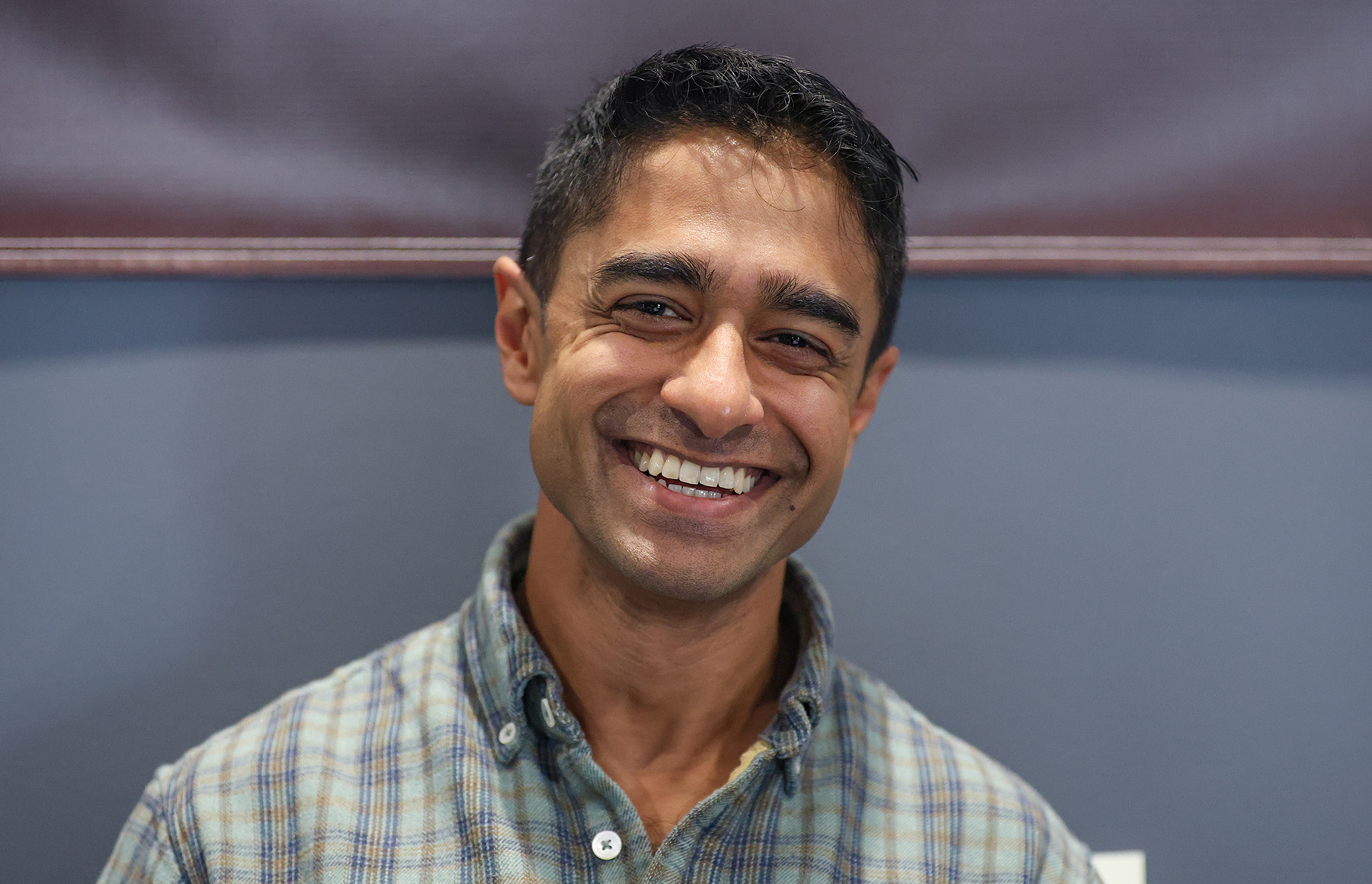
Roughly a week before the Jan. 7 candidate forum, I sat down with Chakrabarti at his campaign headquarters in the Inner Sunset. As Chan and Wiener already occupied the existing San Francisco political binary, Chakrabarti advertised himself as something different — something new — an anti-establishment candidate looking to tear down the Democratic status quo and everyone who enables it.
“After Trump won, I saw the Democratic Party’s response to (the election), and I got more and more frustrated. I don’t think they are taking this moment seriously,” Chakrabarti said. “I don’t think (the Democrats) are really envisioning how to restore the American Dream, because I think that’s why we have Trump today.”
Chakrabarti is a political outsider. He has never previously run for office, and his campaign has been working hard to raise his public profile. He advertises his political style as a sort of militant progressivism, something he says is necessary as the country falls to Trump’s “authoritarian coup.”
Chakrabarti said Trump, like Obama in 2008, embodied “bold, sweeping economic change,” something Kamala Harris and the current Democratic platform fail to do. His message echoed Zohran Mamdani’s New York mayoral campaign, which addressed affordability and the cost-of-living crisis. But Chakrabarti went further, advocating nationwide eradication of corporate Democrats who enable Trump’s takedown of American democracy.
While Chan is no slouch on the anti-Trump rhetoric, she is careful not to attack her own party, telling me she looks to “continue the tradition” of Nancy Pelosi. More central to Chan’s campaign are the people of San Francisco, often speaking to the needs of the working class and labor.
Despite Chakrabarti’s repeated references to Mamdani on the campaign trail and in his opening statement at the Jan. 7 forum, the candidate has some notable differences.
Chakrabarti is not a democratic socialist like Mamdani; in fact, he told me, “I’m not an anything-ist.” While his policy agenda includes many DSA talking points and his PAC, Justice Democrats, has propelled DSA candidates into Congress, Chakrabarti said the issue with the tag is the pigeonholing it enables, stating, “I don’t think it’s helpful to lead with a label like that.”
His distance from DSA is not new; Chakrabarti has faced criticism from San Francisco leftists after he helped fund a successful campaign to oust DSA member and progressive stalwart Supervisor Dean Preston in 2024.
On the other hand, Chan previously worked for progressive candidate Aaron Peskin and has deep ties to the city’s working-class community, racking up major endorsements from the city’s powerful labor unions, including the Service Employees International Union, the San Francisco Labor Council and the California Teachers Association, among others.
“My campaign isn’t built on donations from billionaires; I can’t fund it with a six figure check,” Chan said in an email. “I’m running because working people are being shut out and I’ve fought my entire life to change that.”
Representing the Richmond District and surrounding areas in the northwest corner of the city as one of 11 representatives on the San Francisco Board of Supervisors, Chan won her seat by a razor-thin margin of 125 votes in 2020 before improving to 1,301 in 2024.
This electoral struggle, paired with low fundraising dollars, places Chan at a distinct disadvantage to Wiener.
In the complex housing battle, San Francisco moderates have at times painted Chan as an obstructionist NIMBY for her staunchly pro-affordable development policies.
Nevertheless, Chan holds herself as the candidate for San Franciscans, touting her record of battling corporate interests in the city and fighting for tenant protections.
“There is a momentum that is building among the Democratic Party with the recognition and understanding that we must break up monopolies for the working people,” Chan told me in an interview. “(Voters) are so frustrated with the federal government. They are so frustrated with this top-down approach of governing that people are focusing on billionaires and corporations and leaving working people behind.”
Chakrabarti similarly said his candidacy is ready to take on the San Francisco billionaire class. His stump speech, however, often falls back to a greater plan: building a nationwide progressive democratic caucus outside the dividing lines of party infighting to defeat the MAGA agenda.
This marked departure from city politicking is reflected in Chakrabarti’s campaign platform of progressivism that feels somewhat detached from San Francisco itself.
After working for Bernie Sanders’ 2016 presidential campaign, Chakrabarti founded Justice Democrats, where he identified Ocasio-Cortez and ran her New York congressional campaign before serving as her chief of staff.
Chakrabarti holds this experience as proof of his progressive credentials and can claim he is the only candidate to have battled in Washington. His bruising rhetoric often proves authentic when citing Ocasio-Cortez, a left hook usually successful in backing down personal attacks of millionaire status and corporate history.
Despite this AOC notoriety, the congresswoman has yet to endorse — or even mention — Chakrabati’s campaign publicly.
“I’m talking with (AOC’s) team, but she’s got a lot to work on her own, and I’m not sure what she’s looking at in terms of her own future the next year or two,” Chakrabarti said when I asked him about this discrepancy. “But yeah, I’ve got a good relationship with her, and of course, I will be asking for everyone’s endorsement.”
For Chakrabarti, endorsements have been hard to come by — especially with Chan’s coalition of local leaders falling behind the San Francisco progressive establishment candidate. Chakrabarti has sought to overcome this disadvantage by demonstrating his breadth and depth of policy priorities, many of which stem directly from his think tank, New Consensus.
On rebuilding the Democratic Party, Chakrabarti’s rhetoric is plainly stronger. Chan will likely be a member of the Democratic majority in 2026, but she did not express a willingness to proactively lead or change it.
When I asked Chan if her party needs to fundamentally change in light of the 2024 failure and Mamdani’s win in New York, she said a shift has already been occurring “organically.”
“With Trump back in the White House, people can see that (Republicans) may talk a lot, but they certainly are not delivering for the American people,” Chan said. “I think that is why you see a sentiment turning back to the Democratic party and looking for us to deliver for them, and we will.”
Path to victory
Chakrabarti is especially strong among young, college-age voters. He spoke to this base at UC Berkeley on Jan. 28, and I attended a College Night forum on Nov. 20, 2025 at his campaign headquarters, during which the candidate and his small team of energetic 20-somethings fielded questions from San Francisco students.
At both events, Chakrabarti found popular appeal as he spoke to the frustrations of a demographic facing a contracting job market and direct oppression by Trump’s onslaught against higher education.
While Chakrabarti’s popularity with young voters has helped him build an impressive canvassing network and an almost daily door-knocking campaign, city demographics are not on his side. Following the pandemic, the San Francisco metropolitan area’s median age grew faster than any other major U.S. city, ranking third nationally at 41 as of 2024, behind only Tampa and Miami.
Chan, on the other hand, may benefit from her ties to San Francisco’s large Asian American community, which makes up 37% of the city’s residents.
An immigrant from Hong Kong, Chan’s campaign launch video prominently featured Chinatown, and her website includes a dedicated Chinese-language page. However, San Francisco’s Chinese Americans often don’t vote along simple ethnic lines, and Chan has previously faced criticism from moderate Asian organizations.
Nevertheless, Chakrabarti faces a more difficult political equation. Moderates on housing and taxation stand with Wiener and his mountain of legislative expertise, while Chan grabs establishment progressives, labor endorsements and ethnically preferential Asian Americans. Young people traditionally don’t vote, and San Francisco is particularly old. Even Mamdani-emboldened democratic socialists may avoid the outsider.
Chakrabarti said he isn’t worried — that’s not the game he’s playing.
While it may be just deflection when facing a troubling path to victory, Chakrabarti said this “inside baseball” style of politics isn’t the way he is running his campaign.
“If I go down the route of like, ‘Who is the exact carve out of people who I can get to vote for me?’ I’m not gonna win that race,” Chakrabarti said. “A campaign like this works by presenting a real message of change that appeals to people directly, not through the normal gatekeepers of the political process.”
If Chakrabarti can effectively utilize social media, new-wave progressive hype, and steal voters from both Chan and Wiener, who are worried about the national democratic outlook, he’s got a shot — especially if he can secure an endorsement from Bernie or Ocasio-Cortez.
Chakrabarti has also proven to be an effective communicator when attacking Wiener, something that will be essential to winning the race if he can get past Chan in the primary.
Chan may be able to ride past Chakrabarti in the primary if she can utilize labor organizations for canvassing and outreach, given her low bankroll. However, in a face-off with Wiener, Chan’s outlook may worry San Francisco progressives as the state senator can outgun her on funding and name recognition.
“We are running against someone in a one-donor campaign, and then we are running against someone with corporations and billionaires on their side. We know that poses a challenge for us, but here we are,” Chan said. “We’re accepting that challenge because we truly believe that in San Francisco, money cannot buy elections. People can win the election, and we’re sticking to it.”
Political history tells us money does win elections. Pelosi was one of the most powerful fundraisers during her reign and still sits on an unspent $9 million war chest. If Chan, who some insiders have theorized to be Pelosi’s pick, can earn her endorsement and money in a post-primary fist fight with Wiener, the underdog may be able to take down the giant.
Chakrabarti can go the distance with anybody, burning funds from his own pocket. But the outsider needs to convince Chan’s progressive base to vote for him in November if he wants to prevail against the frontrunner.
This race is Wiener’s to lose. The state lawmaker is a proven entity, a progressive by almost every national metric and a staunch anti-MAGA democratic loyalist who can politick at an all-star level.
San Francisco elections are messy, but its politicians are among the most powerful and influential in the recent history of our nation. Its representative can lead Congress for decades and reshape the Democratic Party for future generations.
So is Rep. Scott Wiener (CA-11) inevitable? Maybe Chan can revive the San Francisco progressive electorate? Or will Chakrabarti’s outsider bid create a fresh Democratic vision in Washington?
I guess we’ll see.