Art and the World
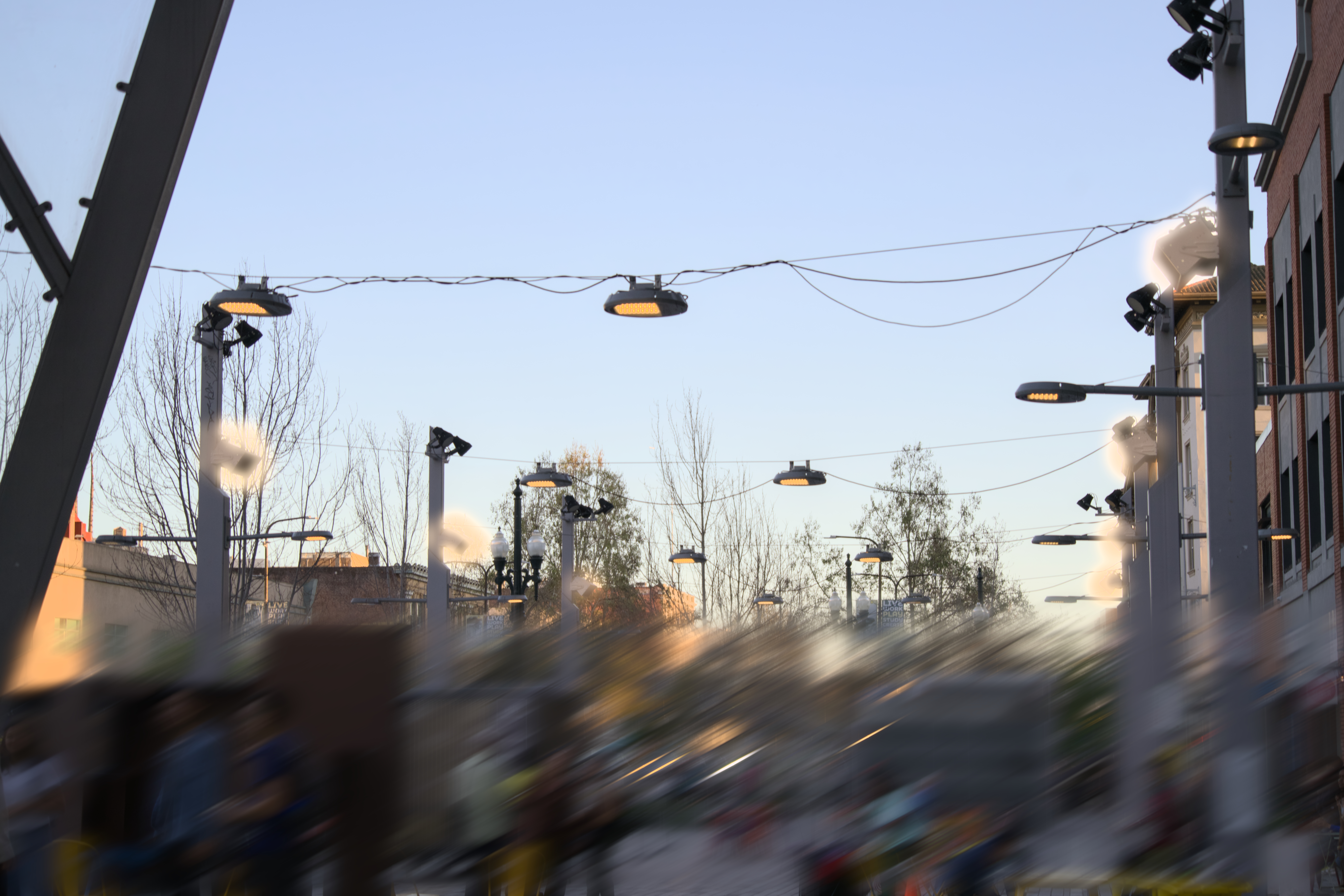
When I first experienced “Berkeley Sonic Prayer Flags,” the sound-art installation that ran at the Downtown Berkeley BART Plaza from January to March, I was caught by surprise. It had just rained and cars were loud on the slick road, so I had to listen closely to catch the music. Artist Jim McKee had curated a two-hour mixtape of live instrumental performances, electronic experiments, and ambient place-recordings from Berkeley’s musical history. He then choreographed it to dance between eight speakers spaced out across the plaza.
It’s an easy thing to miss. Pedestrians exiting the station often pass by, focused on their own tasks or their own music, and during the day the Sliver Pizzeria facing the plaza can overpower the installation with its own playlist of pre-approved customer-friendly top hits. The installation is funded by the City of Berkeley’s Civic Arts Program, which also supports the Cube Space Gallery, a large glass box which houses a rotating material art installation. Civic Arts has been working with artists to create new rotating installations in the plaza for the last five years. Both spaces insert works of art into the Downtown Berkeley environment without any mediating barrier. Simply walking down Shattuck could place you face to face (or ear to ear) with a work of art. And it is worthwhile to take a moment to listen.
After the track I heard finished — a recording of the traditional Indonesian metal percussion instrument known as the gamelan — another speaker began to play a repeated drumming sound like a tap, tap, tap. It was pleasant and sounded as if it was approaching me. Then I realized that what I was actually hearing was someone’s suitcase, bumping up and down on the sidewalk as it rolled behind its owner. I was reminded of a story McKee told me in our interview. Across the street from his home, he said, sit a couple of palm trees: “They’re high enough up that they catch the wind sometimes and I tell people when they come by, they look up and hear it, and I say, well this is my personal sound design.”
“I think that the world is full of art,” McKee said. “It’s a question of perception.”
The World as Art
“Berkeley Sonic Prayer Flags” challenges traditional notions of art as something which is created but is not in the world. A hammer is created but it is in the world; its entire purpose is to interact with the world, to alter it. But when a painting is created, who can say what its intended impact is or how it will be achieved? Art enacts its change onto the world not by being part of the world, like the hammer, but by being apart from it. It is this separateness which enables us to be pulled into the art and then taken somewhere else entirely.
But what is so striking about “Berkeley Sonic Prayer Flags,” and public sound art in general, is that it seems to move in the opposite direction. It is created and it works to return us to the world. We place our ears into ‘music mode’ to listen to the recording from one speaker and then, once it finishes, we listen for the next sound — only, it might just come from the space around us. “Berkeley Sonic Prayer Flags” teaches us to treat the world as art.
Art in the World
Moving through the world requires us to forget that so much around us was created by other fallible people. We must temporarily forget, for example, that the BART train’s underwater tunnel was designed by flawed and irrational humans, lest we fear it too greatly to enter. Thus we often define the world, when we aren’t thinking about it, as that which is uncreated, or that which we found as it is.
But it would also do us good to remember and rediscover the ever-present creation around us. To remember that the current organization of our world, from our social norms to the way our economy is structured, are itself just the products of other humans’ hands. Public sound art, with its blurry boundary between what it is and what it is not, allows us to believe that the sound of a suitcase at this specific moment in this specific time could somehow be intentional. The exhibit teaches us to find the beauty in the way the rush of a passing car plays off the tones of a gamelan. There is, we come to learn, music everywhere.
With our art goggles on, everything we see can be beautiful, and, perhaps more importantly, nothing can be seen as impervious to change. If we realize, or pretend, that everything around us was created by someone like us, we know too that we can create it anew and again. This is what seems to me the most remarkable effect which public sound art is capable of: returning ourselves and our creative powers back into the world from whence they came.
Berkeley has its own song. Every city does. “Berkeley Sonic Prayer Flags” ended its run March 31 and the Civic Arts Program is currently running a competition to select its next artist. In the meantime, our song continues, composed of different instruments: raised voices, spinning bike gears, seagulls. Most importantly, though, our song is always composed by and composed of us — all the people and objects which make up our place.