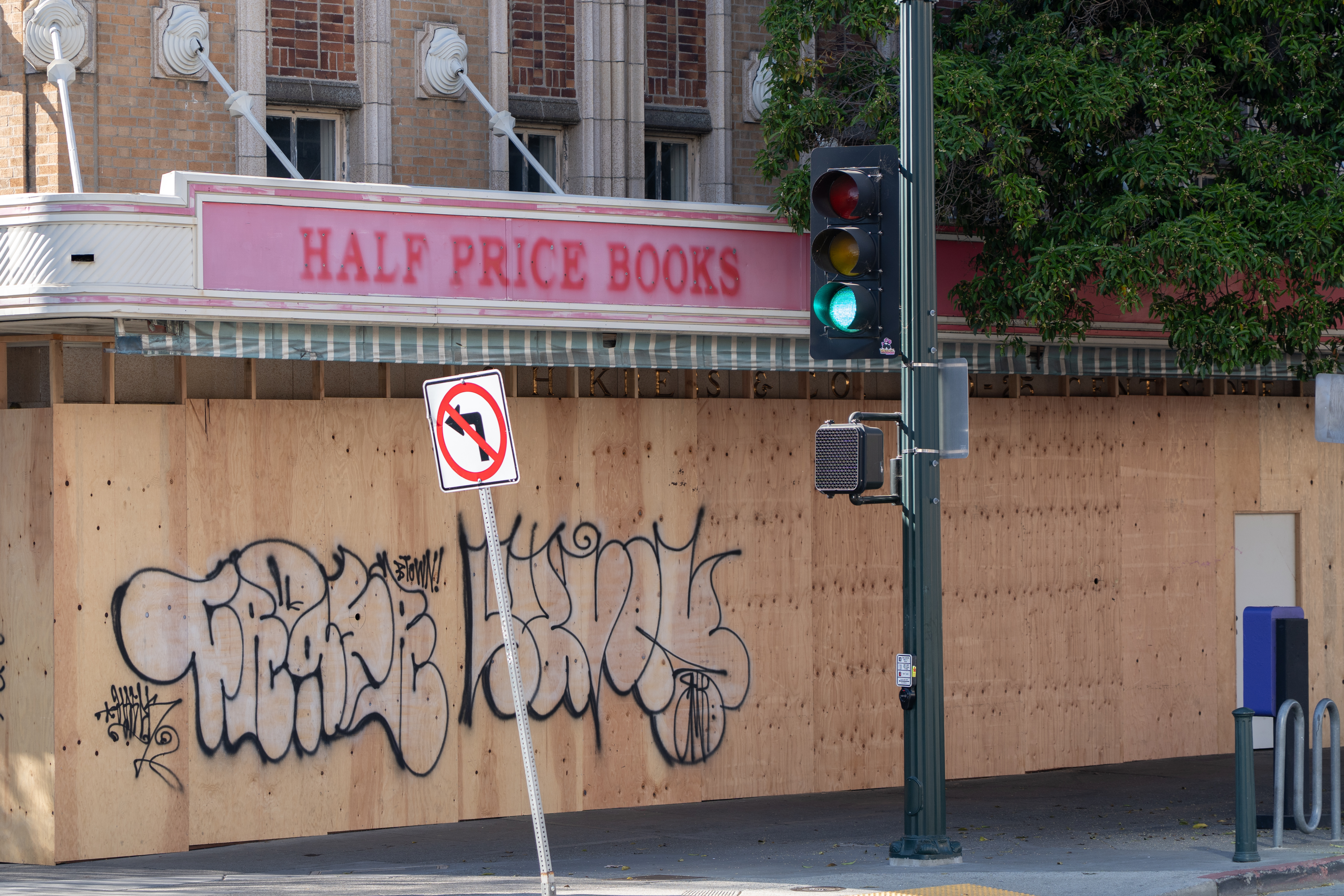
A spectre is haunting Berkeley — the spectre of bookstores dearly departed.
Berkeley mourns the loss of Cody’s Books, Shakespeare & Co, Eastwind Books, Black Oak Books, Half Price Books and Books Inc. — disappearances that disrupt the political and imaginative landscape of the city.
These sites are more than shelves for purchase; they are also part of a long history of Berkeley’s libraries and bookstores hosting free events for writers to engage in dialogue with local audiences. Bee Gabriel, a bookseller at Pegasus Books in Downtown Berkeley, remembers being invited by disability rights activist Alice Wong to sell books at a rooftop party in Oakland’s Chinatown. Pegasus Books also hosts monthly Lyrics & Dirges poetry readings organized by East Bay poets MK Chavez and Sharon Coleman.
“Poetry is … uniquely reliant on readings and small community gatherings, and to have a contiguous space like L&D has fostered many connections,” Gabriel said.
Reading in community complicates our understanding of a single piece of literature and must therefore unsettle our preconceived perceptions of the world around us. For example, Gabriel is an “opportunist” who, among other individual reading habits, “bid(es) the time” until a “revolution” by attending talks on workplace organizing and “reading (Jacques) Derrida and Theresa Hak-Kyung Cha while listening to noise music and watching Korean cinema.”
Berkeley has witnessed the rise of the Free Speech Movement, the Disability Rights Movement and the Independent Living Movement. Most recently, it has also witnessed the “Free Palestine” encampment and other protests against Israel’s ongoing genocide of the Palestinian people. Despite the city’s long legacy of political organizing, I find it increasingly harder to locate text-based organizing efforts such as the lectures and reading groups I attended during the encampment. About two years ago, I attended a student-led lecture on Sproul Plaza regarding the role of disability theory and activism in the fight for Palestinian liberation. I remember heading straight to Moe’s to purchase a book the organizers recommended immediately afterward, grateful for my close proximity to Berkeley’s revolutionary discussions and bookstores.
Like changing one’s mind, reading in community with others is hard. As the closures of local bookstores precipitate the collapse of inexpensive booksellers and free events with authors, residents’ efforts to inform political perspectives and fight fascism with historical context become more abstract. Without as many places to read and talk in community with others, Berkeley’s revolutionary history will remain a history — never a future.
I know no more about imagining a better world than any other reader, but I do know that I feel most creative and alive to the possibility of a more equitable future when I am reading with people I care about. Every week, I attend a small book club made up of Berkeley English majors and discuss a piece of short fiction. We organize “book crawls” at various used bookstores nearby, attend protests and exhibitions, and constantly exchange information, gossip, and histories. These people are my truest friends at college, and reading with them every week has enabled me to imagine a future in reading, writing and organizing — especially in bookstores such as Pegasus and Moe’s that have not yet closed their doors.
As Berkeley residents strive to maintain a critical, revolutionary and communal culture, the constant expansion of our literary horizons to encompass hidden or vanishing perspectives becomes even more essential. We must recycle Berkeley’s various spectres — long-dead bookstores and writers barely scraping by — into new medleys that cease to haunt us. In short, Berkeley residents must participate in local bookstore events and read, together, if we are to collectively imagine a literate future that will feed our city’s revolutionary roots.