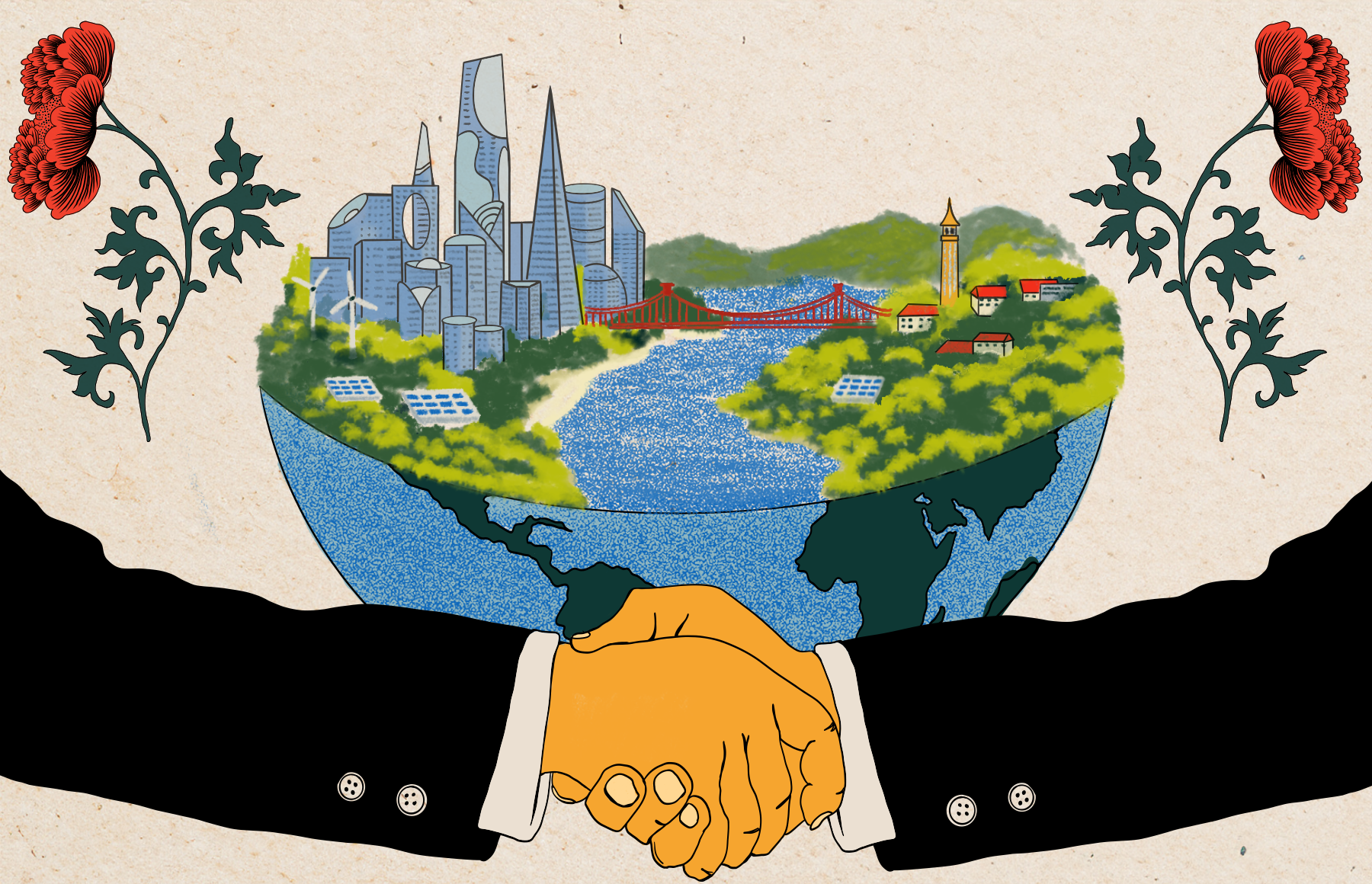
“The year is 2050. You walk to the kitchen and turn on the sink. Water from the ocean pours out of the faucet. It’s fresh and clear, piped from a desalination plant… across the street, an autonomous drone is dropping off the latest shipment of star pills.”
“Abundance,” written by influential journalists Ezra Klein and Derek Thompson, begins with lofty promises. The authors insist that “star pills” are not a far-flung technical future but a realistic political possibility.
The book’s prescriptions have broken through to the political mainstream. Presidential hopeful Gavin Newsom, upon signing a housing bill last June, proclaimed his support for a “ transformational abundance agenda,” and it has crept its way into the speech of the political consultancy class and The New York Times.
Berkeley’s relatively new Students for Abundance, a club committed to actualizing this future, convened a panel in February in the sun-soaked chamber of the ASUC Senate. I sat in, surrounded by a who’s who of important figures in political science and government. The club is unique among campus political clubs in its proximity to the powerful and its deregulatory agenda.
Given the movement’s avowedly insider nature, I couldn’t help but wonder what they needed student activists for. Students are not the well-connected, wealthy insiders to whom such a movement seems to appeal. Nevertheless, in just one semester, the group has grown to include 20 committed members who routinely participate in speaker events and private dinners with professors and politicians alike.
UC Berkeley political science professor Sarah Anzia, one of Students for Abundance’s panelists, introduced the movement’s political program. “Some of the challenge of abundance is that we might have too many opportunities for (political) participation,” she said.
Nationally and statewide, the abundance project is committed to the idea of remedying an increasing cost of living. Real wages have not kept pace with a skyrocketing cost of living and class mobility for most Americans feels, to be generous, unlikely.
The panelists’ explanation for the rising cost of living seemed threefold: declining innovation, organized opposition from local groups (the panelists, in particular, seemed to hold “public-sector unions” in disdain) and burdensome climate and safety regulations that make the completion of public or private projects more difficult.
Characteristically, abundance frames itself as nonideological, or at least as differently ideological than current leftist politics. Johns Hopkins University professor Steven Teles, another panelist, described the movement as “alternative dimension politics” that elides the conventional left-right continuum. Anzia argued that “ideological commitments get in the way” of good government.
This makes one of its central contentions — that it is locked in a fight for the future of the Democratic Party — even stranger. Teles described the opposition to San Francisco Mayor Daniel Lurie, an abundance darling, as a “coalition of horribles.”
UC Santa Barbara professor Leah Stokes, a third panelist, elaborated on the discord between the abundance wing and the more avowedly progressive wing of the Democratic Party.
“That’s an alternative vision for the master narrative of the Democratic Party right now. There’s the abundance narrative, affordability, and then there’s this anti-oligarchy, help everyday people, screw the rich and the billionaires narrative,” Stokes said.
Stokes is right. The abundance movement has ingratiated itself to power, especially in California. Sitting politicians who have openly embraced the book’s dictums for how governance should operate include Newsom and state Sen. Scott Wiener.
Outside of moderate Democrats, the movement has, surprisingly, found a home in some sections of the political right. The panelists discussed seeing abundance advocates push for an abundance of clean energy alongside an “abundance of deportations.”
Categorizing opposition to the agenda is more difficult. Certainly, senators such as Bernie Sanders have dismissed it as a nonmovement. Left critics occasionally deride it as a ploy for a neoliberal deregulation politics that would do the public no more favors than its Reaganite 1980s counterpart. Thompson rejects this characterization, claiming politicians as far-ranging as Zohran Mamdani and the moderate right buy into abundance’s philosophy. The intuitive unlikeliness of this fact did not seem to bother the room.
When I caught up with Maxwell Stern, the president of the Berkeley chapter of Students for Abundance, he struck me as an indispensable link between movement academics and the student body. He is an affable, charismatic face for a movement that is self-consciously full of the economically and politically powerful. Public policy advocates require talented rhetoricians; Stern seemed to be both.
Stern described the club as filled with “doers.” Curious, I asked him what exactly they did.
“We’re listening to (administrators) and hearing what they are saying and where could we, as students, help?”
To me, this sounded less like a student political organization and more like an unpaid consultancy for the UC system. More generally, the political ethos of Students for Abundance seems to be that it should be easier for the government to do things, decoupled from a particular ideological valence. Their website links to a page which promises an alliance with “market-oriented leaders on the right” who value a “limited yet effective” government.
The movement may exist at a hostile time for what Teles called a “professional insurgency” in politics. More than 50% of Americans see both major political parties as “out of touch.” In the case of Democrats, this may be driven by a paternalistic insistence that the cost of living crisis needs measured policy and slow solutions. When I asked Stern if he thought it mattered to win electoral support for the movement’s policies before implementing them, he told me that “the public can support these things when they see results and then decide.”
Taken together, this all reads as dangerous. After all, couldn’t ideologically neutral state capacity just as easily be used to build prisons as it could wind farms?
Despite its claim to ideological neutrality, abundance seems to reveal certain deep political commitments.
“Billionaires are not a unified ideological class,” Thompson said toward the end of the panel. The implicit presumption seemed to be that billionaires would be useful allies in the cost-lowering revolution abundance would inaugurate.
For a group manifestly committed to the idea that people may have political interests uncaptured by left-right ideology, the abundance crowd seems to place quite a bit of faith in left-leaning billionaires to act in the best interests of the general public. The structural class interest of billionaires is in protecting their capital, not servicing the interests of a democratic public. Billionaire electoral spending seems to support this, suggesting that billionaires consistently close ranks against redistributive tax policies which would meaningfully uplift the working class.
The movement’s embrace of billionaires, as with much of the movement, seemed to derive from a wonkish political pragmatism surrounding technological advancement. In a distinctly Bay Area spirit, the movement seems to believe that technology will deliver us from the sins of climate change, scarcity, and a host of other problems. It’s notable that the example both Thompson and Stern provided for a movement-aligned billionaire was Patrick Collison, co-founder of a payment platform called Stripe.
Collison, in a broader rightward shift from a tech industry averse to regulation, donated $200,000 to Republican PACs ahead of the 2024 election. Stripe spent over $1M on federal lobbying efforts in 2025, a portion of which advocated for the One Big Beautiful Bill Act.
The introduction to “Abundance” extols the virtue of “skyscraper farms,” of “e-bots,” and of “higher productivity from AI.” This is, of course, set against the spectre of an automation-driven unemployment crisis, a virtually unregulated artificial intelligence industry, and essentially no promise that the productivity benefits of new technologies will be distributed in the form of higher wages or quality of life for workers.
Suspecting that Students for Abundance shared Thompson’s pragmatism, I asked Stern what the club would do with unlimited resources. “There might be small ways of marginally improving the administration to ensure that students are better off… we have to be pragmatic about how much change a student can actually make,” he told me.
Thinking of the monuments to the Free Speech Movement a thousand feet from where we sat, I wondered if that was true.
I asked Rithika Ramesh, a co-chair of campus’s Young Democratic Socialists of America, the same question.
“Personally, I would like to do a lot more mutual aid … the University of Oregon YDSA just won a campaign on their campus where they were able to get abortion medication for students for free.”
Later, Stern invited me to a “no-phones” party put on by Students for Abundance. Toward the end of the night, a friend and I collected our phones and prepared to leave. Each of us had a plethora of notifications: the United States had just begun a military campaign against Iran. We spoke, panicked, about the implications of the strike.
Next to me, I heard a member of Students for Abundance exclaim. He was excited: we would achieve regime change and Iran would be a democracy. I heard echoes of the technocratic insistence on “nation-building,” “democratic peace” and market integration that preceded the American invasion of Iraq. Newly afraid of the future, I walked away from the frat-hosted analog party.