
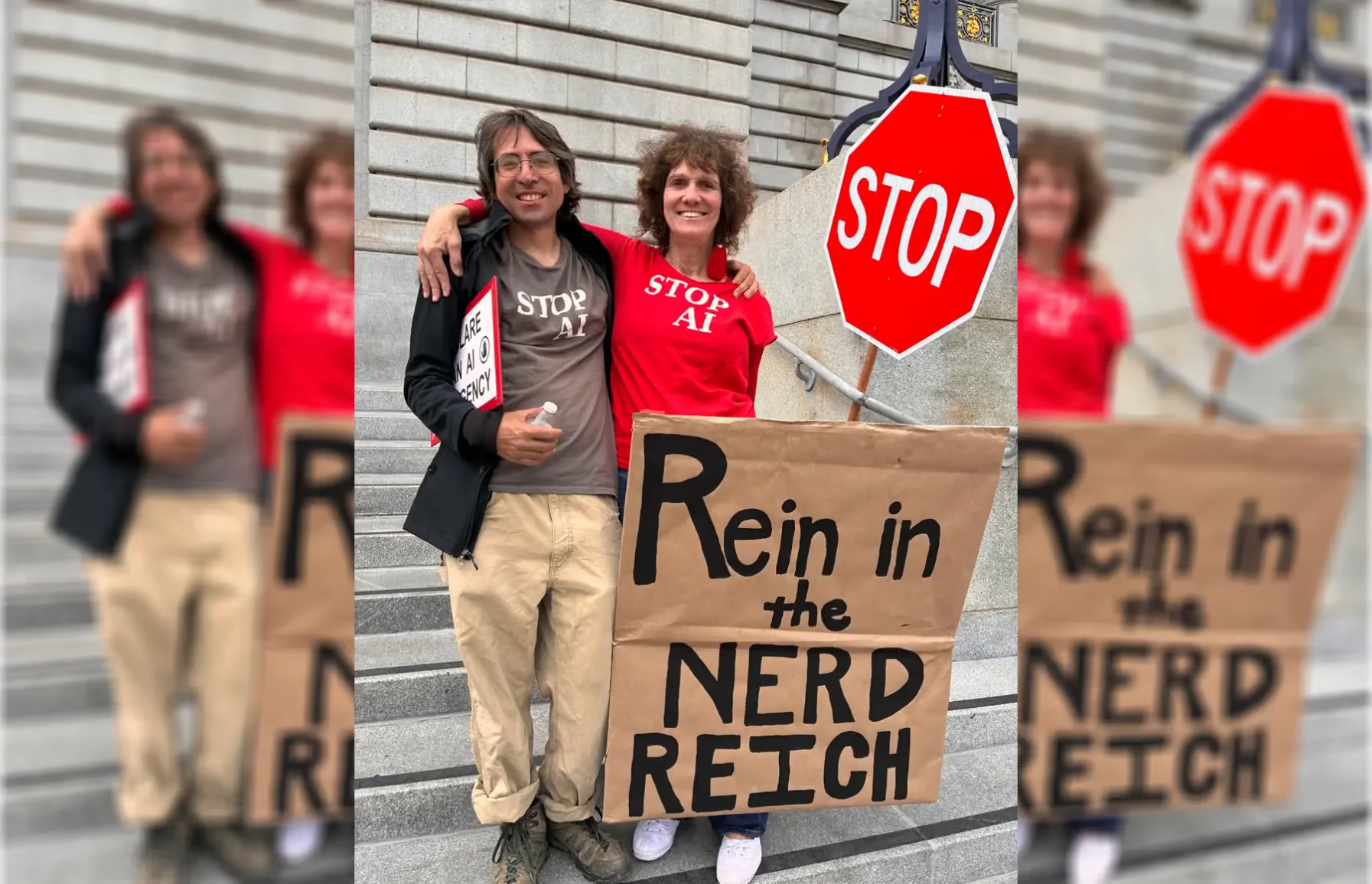
Wynd Kaufmyn and Guido Reichstadter are something of an odd couple.
Kaufmyn, 69, is charismatic and outgoing. She is always well dressed, adorned in bell-bottoms and loud jewelry. Talking to her, she is sometimes interrupted by phone calls from friends in Jewish Voice for Peace or CODEPINK. Reichstadter, 46, is reserved and contemplative. He is careful with his words. When he is not with Kaufmyn, it is rare to see him crack a smile.
A UC Berkeley alumni and long-time resident, Kaufmyn recently became the first person to receive jail time for taking part in an anti-AI protest. On February 22, Kaufmyn and Reichstadter, along with three other protesters from anti-AI advocacy group Stop AI, chained shut the doors of OpenAI headquarters. When police arrived on the scene, Kaufmyn, sitting in front of the doors, refused to move.
Almost five months later, on June 9, Kaufmyn was convicted of interfering with a business, trespassing with intent to interfere with a business, unlawful assembly and refusal to disperse at a riot.
While much of the media attention has focused on Kaufmyn, this story is not complete without Reichstadter, the co-founder of Stop AI and Kaufmyn’s new boyfriend.
Hailing from Florida, Reichstadter’s apprehension over AI began in the early 2000s while studying math and physics at the University of Florida. As he describes it, he “came across some message boards,” where he heard early whispers of Artificial General Intelligence, or AGI.
“As soon as I comprehended what AGI would be, the implications for human society and the future of humankind became pretty stark,” Reichstadter said. “(I was) just trying to get a hold of whether folks thought this might be technically feasible.”
Following the release of ChatGPT in 2022, Reichstadter became convinced that the existential risk posed by AGI, once a matter of speculation, was becoming a reality. In early 2024, he found a community that shared his concerns on the PauseAI discord — another anti-AI advocacy group — and decided to begin a new life in the Bay.
Within a few months of moving to the Bay, Reichstadter would meet Sam Kirchner online, a fellow anti-AI activist. Together, they would grow frustrated with PauseAI’s tactics and go on to found Stop AI, which distinguished itself from PauseAI through its willingness to “break laws nonviolently.”
Here, it is worth noting that “breaking laws nonviolently” is largely unpopular in anti-AI spaces. There are many anti-AI organizations in the Bay Area — Stop AI is the only one that has seen arrests. In this respect, Kaufmyn and Reichstadter occupy the most radical wing of anti-AI organizing.
On August 21, Kaufmyn was released from jail. Reichstadter went to pick her up, but by the time he arrived she had already left to attend a protest outside the Israeli embassy. Later that day, we met up for drinks. Kaufmyn and Reichstadter were in high spirits.
When Kaufmyn met Reichstadter in November 2024, he was homeless. Living out of a Quaker-run shelter in San Francisco with Kirchner, Reichstadter was informed of a protest outside of Travis Air Force Base.
“The Spirit calls you to say something,” Reichstadter explained. They decided to attend in hopes of spreading the anti-AI message. There, he met Kaufmyn.
“As soon as I stepped out of the car, I see Wynd in the center of this circle, bringing chaos to order,” Reichstadter recalled. “It was love at first sight.”
Kaufmyn, for her part, remembers it differently. As a longtime organizer against Israeli apartheid, Kaufmyn had shown up to Travis Air Force Base as part of a larger campaign to halt weapons shipments to Israel.
“I was at the megaphone telling people the plan for the day, and there were these two men,” Kaufmyn said. “(Reichstadter) had a gray hoodie … and he was recessed a little bit in the hood … I was like okay — this is an undocumented immigrant.”
“In a sense, it’s true,” Reichstadter added. “I feel like a small woodland animal in the form of a man.”
After meeting Reichstadter, Kaufmyn began attending Stop AI meetings. There, Kirchner introduced her to the idea of existential risk. Kaufmyn, who was already opposed to AI on political grounds, was nonetheless taken aback.
“I remember talking to all my friends about it,” she said, “and most of them (thought it was) crazy talk, but I didn’t think so.”
Not long after this, Kaufmyn would start attending Stop AI demonstrations. A few months later, she would arrive at OpenAI headquarters to find Reichstadter, along with other members of Stop AI, sitting in front of the doors and decide to join them. As she recalls, she “looked at them, these four males, and was like, ‘oh my god, we need more diversity.’”
After the arrests, Reichstadter would double down, embarking on a hunger strike outside of the Anthropic building in San Francisco. During this time, Kaufmyn would visit him often.
A few weeks later, Reichstadter would ask Kaufmyn out for dinner and a movie. She countered the offer by inviting him to the No Kings demonstration in Oakland. As the demonstration ended, Kaufmyn confronted Reichstadter about their age gap. They decided on being friends.
“A week later,” Kaufmyn recalled, “we went to another demonstration together. On the train ride home, we were kissing. The rest, as they say, is history.”
Since then, neither of them have slowed down. It seems, for Kaufmyn and Reichstadter, the end of days have marked the beginning of something new.
Following Kaufmyn’s citation outside of OpenAI, she would become an organizer of Stop AI. Reichstadter, for his part, would head over to Washington, D.C. to protest on top of the 168-foot tall Frederick Douglass Memorial Bridge. During Kaufmyn’s trial, Reichstadter remained in the courtroom for support. When Kaufmyn was sentenced, he stood up and belted an anti-AI ballad. Later, he would go to her home to watch her house.
Today, both Kaufmyn and Reichstadter have stay-away orders which bar them from the OpenAI offices. Unfettered, they have decided to refocus their efforts on city hall, protesting every week about the dangers of unchecked AI development.
As our conversation wrapped up, the sun started to set. A waiter stopped by to drop off their matching Guinness floats, and Kaufmyn smiled.
“I’m so happy with Guido,” she said. “How did we find each other? I know it’s weird, and I still feel a little uncomfortable about the age difference.”
“I don’t,” Reichstadter interjected. They both laughed.
“I know, which I’m grateful for,” she replied.
As of press time, Kaufmyn and Reichstadter have broken up. They both plan to continue with their anti-AI activism. According to Kaufmyn, they are “still in love.” Reichstadter, for his part, maintains that human interest pieces are not important in the face of impending AI doom.