
San Francisco, 1957
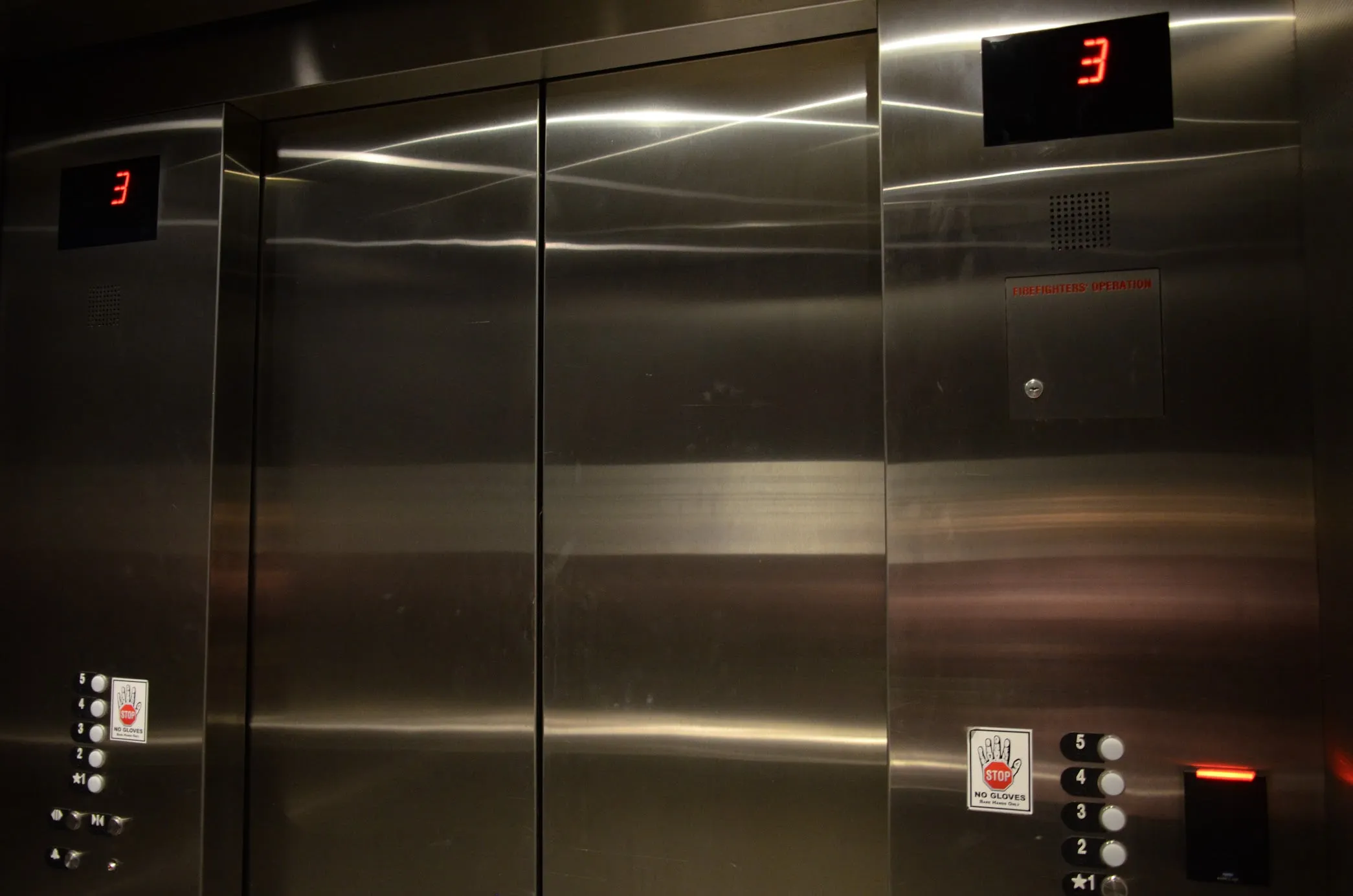
The “8” button, once silver, was now brass-colored from 11 months of endless presses since the last time the elevator was fully inspected and serviced. The walls, dark mahogany, were complacently hidden between the Turkish mohair rug on the cab’s floor and the mirrored ceiling, all in unison like a row of young ducklings. The man slightly adjusted his posture, felt the uncomfortable nature of a straight back for a few seconds, and then slouched back down. It’d been about 2 ½ years since he began working as an elevator operator. His name was Aleksei, and he thought of himself as an honest everyman.
He always spoke in a way where you did not need to see his expression; you could tell he was smiling just from the sound of his voice. He moved to the States from Slovakia when he was 10, and ever since then, he had been chasing the American dream, constantly trying to make a name for himself.
“Going down. Floor six up next,” he said, barely pausing for a breath in between each word.
There was no notice or attention sent his way.
A woman, wearing a dress whose pattern she had ordered directly from the latest issue of Vogue, stood staring ahead of her as if her eyes could see through the walls. A short, stout man with glasses too small for his face waited in the opposite corner, repeatedly glancing down at his feet, trying to avoid all gazes. He was praying that no one else would step in at the next floor. He had been sweating through his suit, and the scent was definitely a pungent one.
There was never any room to think in that little box. Aleksei liked to call himself “The Old Man,” pretending he was the captain on a ship, recently promoted to be in charge of both the port and starboard sides. He was not old at all, in fact, having just recently turned 24, and his boat fantasy was unfortunately not true either. He spent most of his days chartering office employees up and down in a corporate building in San Francisco. The heart of the Financial District. Up and down.
It had always been good work that he did not really mind, but he did often think about how he probably had a different life path awaiting him. He just had no idea what it was yet. Aleksei was on the cusp of some grand idea: a transformation, a way to change his life. The issue was that he had no clue what it was going to be, no matter how hard he kept digging.
For a while after he got hired, he would pass the time by listening in on the conversations around him as he rode. Every breath he took was more shallow than the previous one, taking his hat on and off, tucking his bangs in and then pulling them out. He had recently realized he’d unconsciously memorized every nook and cranny of the elevator, every slight scratch on the walls. He started to feel claustrophobic within the confines of the wooden crate.
Among the next set of people riding was a young boy holding a model airplane and his visitor badge. He was hiding behind his father and gripping onto his larger hand for dear life, while sniffling and rubbing the snot away with his knuckles. The man, about 50, was a frequent elevator-goer, typically adorned in fitted navy blue suits and expensive-looking sunglasses, who never acknowledged Aleksei much at all. Today, he looked down at his son and said, “Your mom will be here to get you soon. You’ll get to eat ice cream.”
Aleksei had always noticed, since he started working in the building, that the man would usually take on an apathetic nature. It was absent at this moment. For the first time, he looked and seemed like a human.
Aleksei watched this unfold in front of him, and for a second, thought to himself: Maybe I should find myself a woman. And get married. And have a child. Perhaps that would give him some direction.
This feeling went away as soon as the boy and his father got off on the 16th floor. There, two interns got on, with their usual friendly smiles and happy dispositions.
Meg and Dan. They had introduced themselves to Aleksei when they first got their jobs, talking at him as they went between floors, delivering coffees and stacks of paper. They were twins, technically fraternal, but borderline identical, both with hair so blond it almost looked white. Their steps always marched on board the elevator in perfect unison, with the sounds of their clacking shoes echoing like gongs. Aleksei sometimes imagined their mother dressing them in the mornings before they got to the office and fixing the wrinkles in their blouses, even though there was no way they were any younger than him. “How’s the Tuesday going, Aleksei?” Meg asked him. She always made sure to say his name when she addressed him, as if to convince him that she was deliberately aware of his existence. He always knew she was.
“Same as usual,” he said, trying his best to keep the conversation short and sweet. He had been in the middle of thinking about his radical, ground-breaking idea, and they had distracted him right before he’d almost figured out how cryogenic teleportation worked. “Any plans tonight?” Dan asked him.
“No, I don’t know. Not very much to do,” he replied.
He was lying. The drawing boards needed to get drawn up. Perhaps he could somehow develop an aptitude for chemistry while he slept if he stuck an encyclopedia under his pillow, and then he could use the freshly obtained knowledge to fashion up a new species of grapefruit or banana. Perhaps buying a piece of fruit could be his first step.
“You should go do something! Dan and I are going out dancing tonight. It’s going to be a hoot,” Meg said to him, looking him straight in the eyes as she spoke, in a way that could only be characterized as the slightest bit less than intense.
Aleksei thought it was funny. Firstly, he hadn’t heard the word “hoot” in quite a while. Secondly, the real extent of their knowledge of each other was limited to that elevator. He wondered if the people he took up and down every day would even recognize him outside of the elevator. Out of uniform.
“No, I don’t think so,” he said. And that was the end of his thought.
He knew that there was planning and theorizing to be done. Meg and Dan looked at each other; he could tell they felt that he had more to say, and that they wanted to fish it out of him. They were kind people, trying to turn work in the office into something more exciting, something closer to life. Meg and Dan worked long hours, from dawn to dusk. Everything they knew was in the building. Perhaps the twins had more in common with him than any of them thought. Aleksei felt like he owed them a second helping of information.
“I’m trying to change my life. Get out of this elevator finally and go do something … awesome. I just can’t quite figure it out,” he told them in a serious tone.
All of a sudden, the elevator reached their destination.
“Second floor. Getting off,” Aleksei said, smiling once more. And then they stepped off.
The elevator was empty, giving Aleksei an opportunity for some contemplation. There were only so many vignettes of people, passing him by on a day-to-day basis. He’d thought he could find some sprinklings of musings from those around him, but they did not come. He had to keep trying.
Eventually, someone pressed a button somewhere, and he started moving again. On the 23rd floor, a man in full denim got on. A real entrepreneur looking fella, Aleksei thought to himself. It was perfect.
The man had soft blue eyes and unruly brown hair. He gave off the impression that he had not slept in days. “What do you do?” Aleksei asked, as eager as he had ever been.
The man looked him up and down, before simply replying, “I work.”
Aleksei didn’t like that answer. He looked across at the mysterious figure, studying his body language. He loosened his tie and hunched his back, attempting to mirror the man’s casual nature.
The man then followed up, “I design things. Houses. Buildings. Elevators, even,” he said, looking around the four corners of the little box. “This is a good one, great bones. Nice build … I’m an architect.”
And just like that, they got to the top floor. The man stepped off before Aleksei could even announce it.
He was alone again, and he was back to square one in the thinking department. All of the people around him acted like they all had everything figured out. Why couldn’t he do it?
He had kept a consistent job for a while now: he was never late, he never really took sick days, and he always cashed in his vacation hours for more pay. Aleksei was great at everything he was, but he just wanted more. There were limits to the working-class American ideology.
The ups and downs of the elevator were never enough.
He needed a change. It felt like it was going to kill him if he couldn’t do it, the cables of the elevator giving him the sensation that they were suffocating his thoughts and cutting off his circulation. There had to be an invention somewhere, or a doodad, or a new plan.
He just had to get up and get out.
Aleksei quickly reached over and pressed the “lobby” button with more passion than he ever had before. His heart started racing, beating in unison with the whirring sounds of the elevator’s decline. It was as if, in that moment, gravity no longer existed, and the little box fell faster than ever, straight from the top to bottom with no stops along the way.
He arrived downstairs and was greeted by a group of people waiting to get on, but he gave out no declaration or recognition. He simply pushed past them, and ran out as fast as he could. Then, he stopped for a second and yelled back: “Do it yourself. Press the buttons. You don’t need me here.” And then he kept running.