
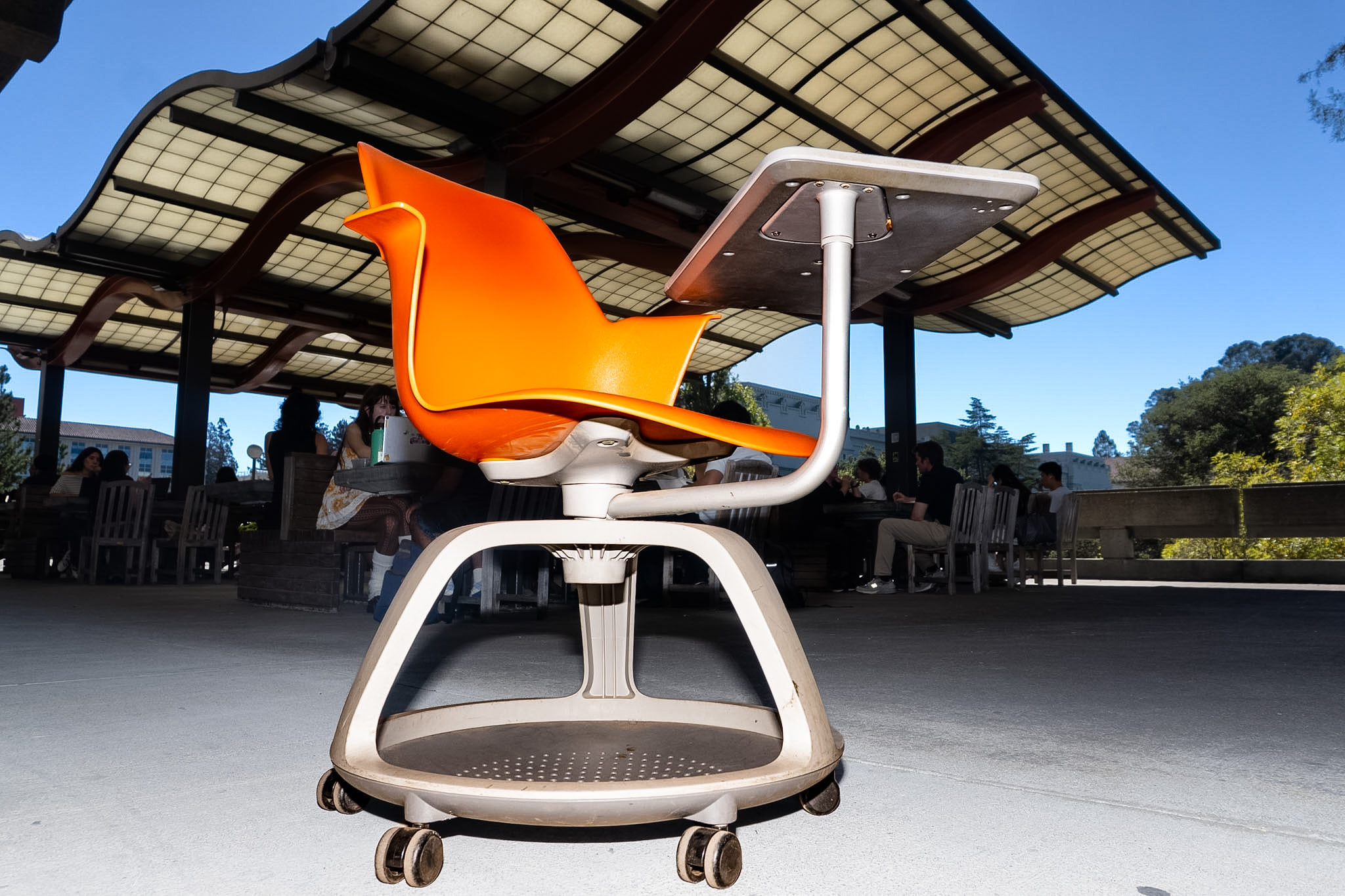
“The furniture had aged without ever having become familiar. People had owned it, but never known it.”
— Toni Morrison
Tucked in the bottom-most floor of the newly renovated library, Moffitt 145 was a vast frontier. Tables of creative height and geometry punctuated the linoleum floor. Bar stools and office chairs floated around the room’s infinitude, some with cushioning, some without; some with wheels, few without. In the middle of the room was a hulking, cement pillar, a product of the recent retrofitting, the anticipation of a near-future cataclysm made manifest.
Here, I would spend three hours every Tuesday in a seminar.
On the first day of class, my professor walked in and looked out into the expanse, a sailor lost at sea. Hardly anyone sat next to someone else; the twenty of us were scattered across at least a hundred chairs. Backpack still on, he frowned, scratched his chin, then frowned again.
A panel on Moffitt’s third floor reads: “Moffitt Library facilitates experimentation and tinkering, and invites curiosity, creativity, and flexibility” — a goal facilitated by modular furniture. The room’s topography, so mobile and diverse, epitomized these principles.
In Moffitt 145, we too felt the spirit of modularity. My professor, subdued, gestured at six chip-shaped desks smushed together in what looked like a dried pineapple ring and said: “Let’s make three more of these.”
We hodge-podged the desks, the amateur designers we were; some of us jutted out of the circle, and others somehow inside of it. But, enthralled by the space’s adaptable fervor, we made it work.
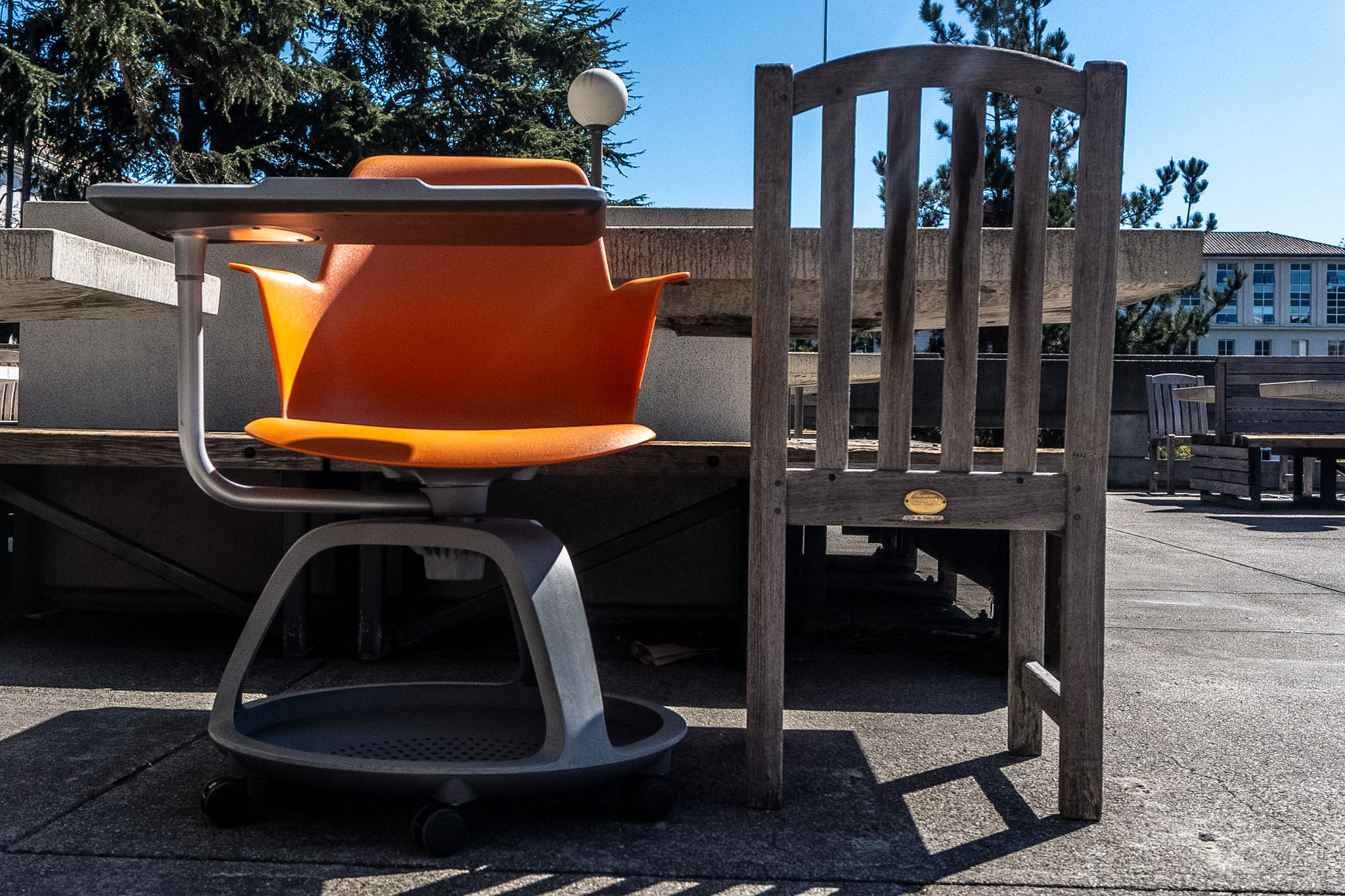
Undoubtedly, the furniture swells with possibility. Without getting up, students can now scoot around in rolling chair desk units, forming discussion groups and circles like bumper cars in an amusement park. Students can now customize their own study spaces “as their needs change,” said Moffitt librarians, removing desk dividers or pushing wooden blocks around to accommodate their pedagogical needs. Modularity, in short, has democratized the process of design.
Still, the furniture was strangely reminiscent of someone void of personality — chameleon-like, blending into every environment without ever truly embodying it, oriented only toward change. Every week, my class returns to Moffitt 145 to recreate the row of pineapple rings, the previous setup no longer there, our setup soon disappearing with the needs of the next class, the furniture already loaded onto their dollies.
I thought, then, of a set of grey couches in Moffitt, how BNIM, the architecture firm behind Moffitt’s redesign, said that “the sectionals under the stairs on Level 1 are intended for relaxation while the same sectional on Level 2 is intended for social interactions.”
In this anarchy of space, it seems that the only constant is change. One piece of furniture, by simply being on a different floor, can fundamentally mean something entirely different. Masquerading behind neutrality, modularity embodies a uniquely American ideal, a promise of infinite possibility with no shortage of personal freedom.
Customize, they tell us. Create. Connect.

I think of my freshman year at UC Berkeley, how I found orientation in campus’s centralized layout. I attended many protests in front of the Mario Savio Steps, where Mario Savio and Martin Luther King Jr. once preached to crowds amassed on Sproul Plaza. I’ve eaten lunch on the cement ledges of Doe Library — the same library protesters occupied in protest of budget cuts and apartheid.
The purpose of fixed configuration has always been to contextualize a space, guiding us to sit, stand, gather, disperse — a manual for how to situate ourselves within a space. The person behind the lectern assumes a position of authority. The person behind the cash register assumes a position of service.
As much as history is situated in space, it is the orientation of space that permits history to actualize, laying the foundation upon which legacy plays out.
Modular furniture rejects this. In attempting to ease the burden of reconfiguration, modularity has sacrificed disposition.
Freedom, as afforded by modularity, is thus freedom from history and orientation. How do we lean against a chair that rolls? How can we orient ourselves against something that itself has no orientation?
The furniture, short of truly easing discussions and customizing learning environments, is reduced to its most basic function: ensuring a return on investment.
Here, UC Berkeley promises that you can be an intellect and a CEO, an academic and a dropout, the past and the future. Modularity, then, is only really functional for a university who needs to shape-shift at the snap of fingers, permitting choice within the bounds of ambiguity, birthing an anguish from the womb of anticipation.
In modern interior design portfolios, there are other office spaces, libraries and university classrooms indistinguishable from UC Berkeley’s. What has been rhetorically asserted as a choice of neutrality was actually a push toward standardization, conflating corporate aesthetics with natural ones, homogenous designs with democratic ones — a space dolled up and ready for anyone and any purpose.
Sure, we can shuffle around classrooms without getting up. And we can now study on high chairs or rolling chairs, wooden blocks or lounge chairs. But humans, adaptable by nature, have never abstained from reconfiguration. Finals week sees bulky chairs dragged around Doe Library as students congregate to cram a semester’s worth of material. Morrison Library often clears hefty tables and their many couches for events they host. As much as wheels would ease the heavy lifting, such benefits are hardly revolutionary: an adaptability that only serves a campus in crisis.
I write this in the North Reading Room, where I often find myself in the strange hours between work and classes.
The ceilings are high, the sound of creaking chairs reverberating through the vast room, the shelves of which are lined with dust and censuses from every American state. I frequent the back tables, the ones with no lamps or outlets. On a good day, the sun beams through the many windows, casting light across the rows of long, wooden tables, their edges darkened and smooth from years of use, water rings tattooed on the wood.
Just a few weeks ago, my cousin, having just transferred here, asked me where to study in Doe Library. “Upstairs,” I said, of course. “It’s really pretty.”
I felt coy about my response, that it was a cliche answer. But I thought of why I liked the library and how I felt like I belonged every time I returned back to the long tables and the walls of books.
In the next decade or so, we may not return to the same UC Berkeley we once studied in. Even now, we rarely return to the same classroom we occupied the week prior. In a world so desperate to develop and produce, there is perhaps no time for orientation. Or perhaps, the commercialization of the furniture is hardly noticeable, nothing still for long enough to warrant attention.
And maybe, that’s the point. At the end of the day, most of us are here not to enrich our souls or to find a place in the world, but to ensure a return on investment, educating ourselves so that we may earn enough money to survive.
But for now, I sit in the North Reading Room, where my cousin texted me weeks ago. After weeks of feeling lonely in pseudo-intellectual discussions and hourlong lectures, she told me from Doe Library: “I feel like a real Berkeley student now.”