
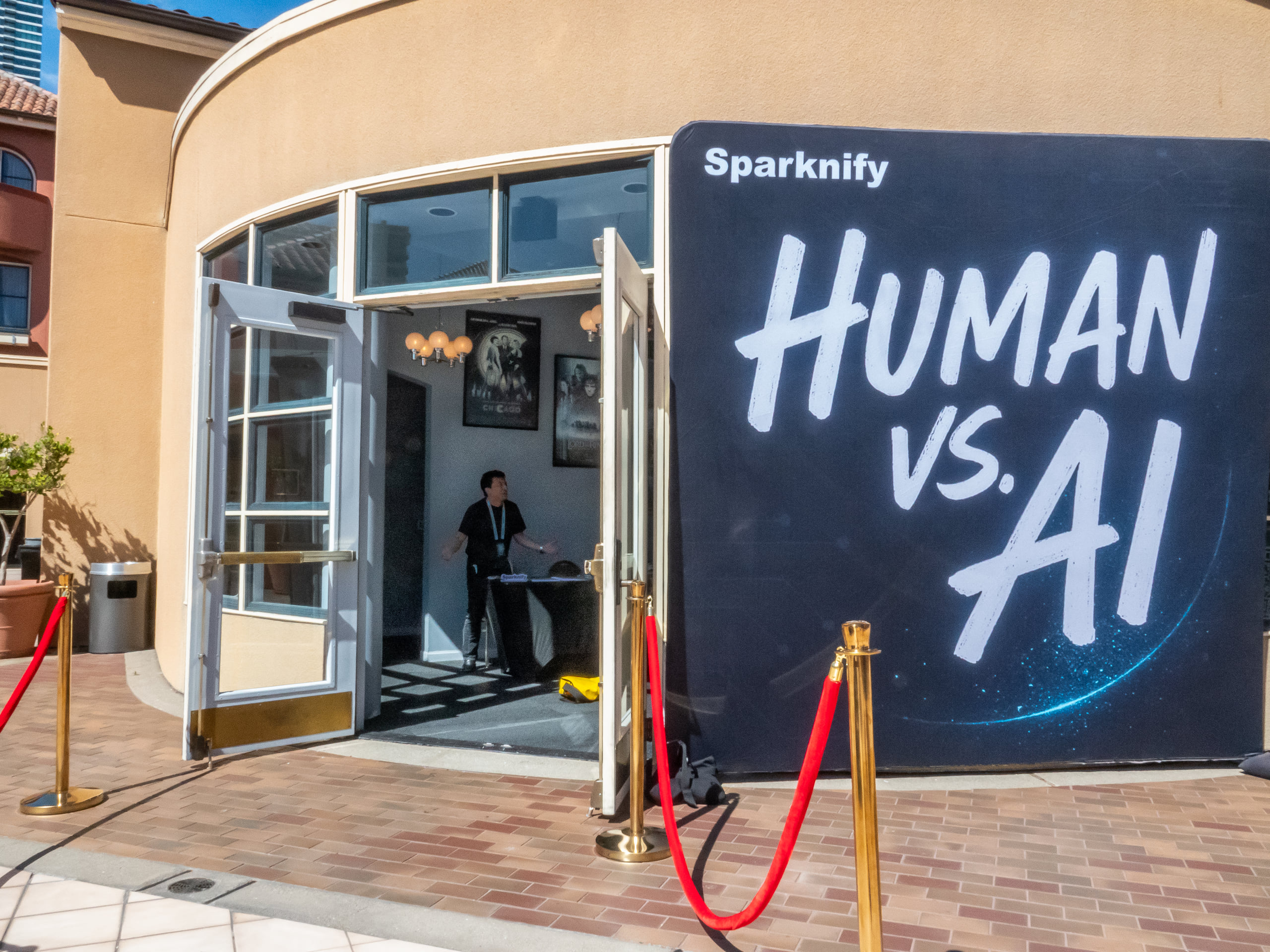
John Huang is a pragmatist. No, he’s a visionary. He sees the future in all its bleakness; he braces. No, he sees the future and is excited; he chases it. He runs a public relations firm, “Sparknify,” but it isn’t enough. So he puts on a movie festival.
Except it’s more of a competition. He calls it the “Human vs. AI Film Premiere” in which human-made films are played alongside films generated by AI. The attendance is sparse, some 25 people dwindle into 11 by the end of the first hour. It is the job of these festivalgoers to discern between the two methods of production. Huang feels confident that you can no longer tell the difference between human and AI film, so he poses a question to his audience: Can AI produce convincing cinematic art?
No. Or maybe not yet.
Gil is a large man who works as a security guard and wears a tucked-in blue flannel shirt, wraparound sunglasses and baseball cap. He puts it nicely: “I could tell which ones were AI.”
He elaborates, “The reason I popped into here is because last week I caught an AI zombie movie on YouTube. It’s about an hour long,” he reflects for a moment, “I was just blown away by it.”
“Did any AI film particularly stand out to you?” I ask.
He says, “The second one, where the maid was a robot.” Did I miss that one? Maybe I forgot it.
As the screening continues, Huang’s question begins to fall apart. The festival reveals whether films were made by humans or AI within a few seconds of their conclusion. There is no time to reflect upon the films. If anything, the human-made films only serve to emphasize the shortcomings of their competition. It seems that the mechanics of the festival have failed its initial premise.
I tell Huang this: “A lot of people that I talked to, they said that they could tell right away.”
“They could, yeah, yeah, yeah,” he admits. But this doesn’t really phase Huang. For one thing, he’s really certain that audiences won’t be able to tell the difference come next year’s festival. For another, he thinks that we’re trying to answer the wrong question.
The real right question, he reveals, is more about whether AI “can touch you better or not.”
The festival is divided into four screening blocks, themed not by genre but, strangely, by what the Sparknify website labels as the “eight fundamental emotions”: “Joy & Sorrow,” “Intensity & Serenity,” “Love & Hate” and “Desire & Disgust.”
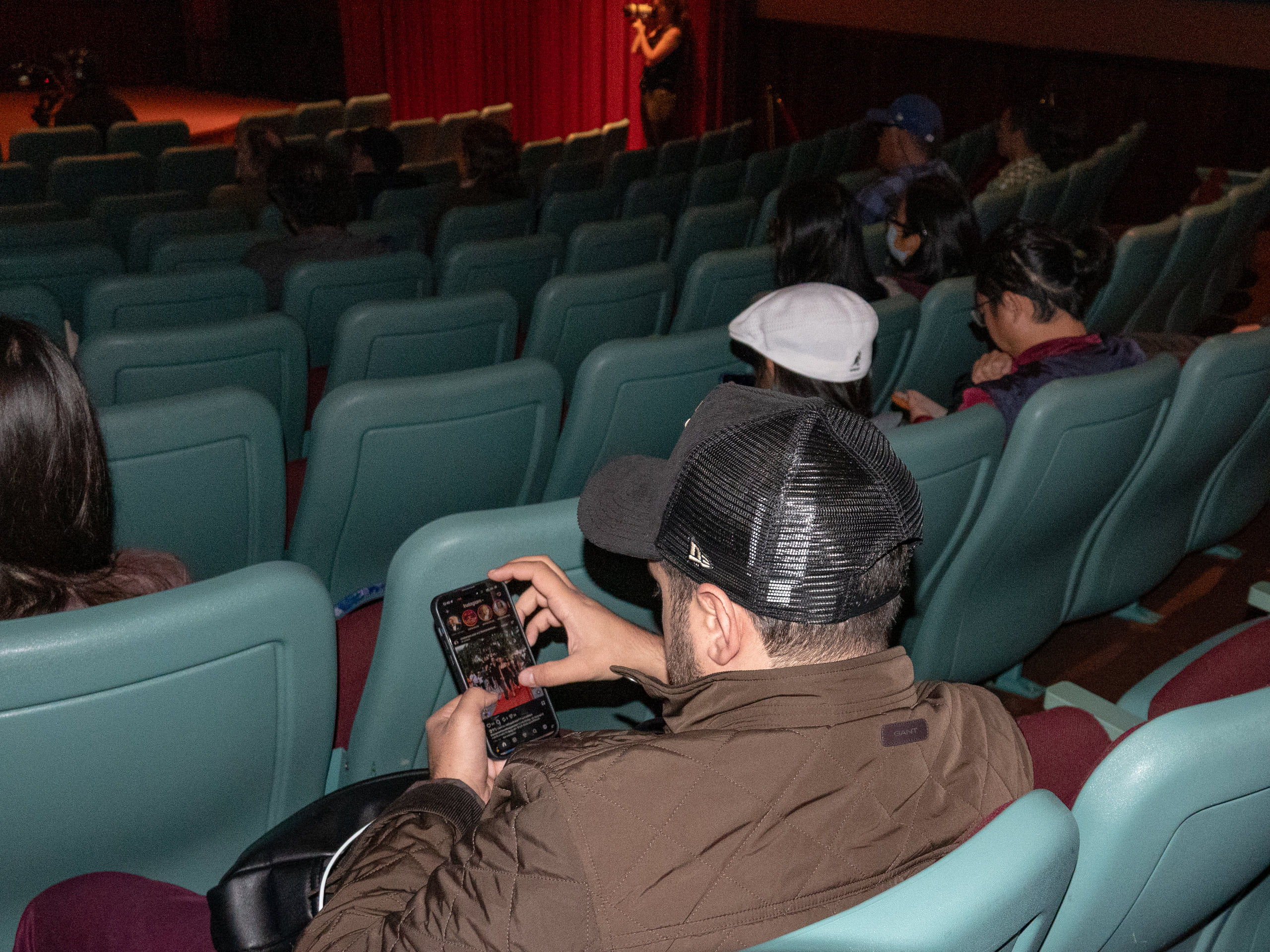
I’m seated at the back of the theater during the “Joy & Sorrow” screening block. One of these films, generated by AI, places feudal Chinese characters in a futuristic Beijing. It jumps wildly between a warrior in a nightclub and a madame on Instagram Live. It’s like watching somebody else play a slot machine. This film is screened right after a human-made movie depicting a Palestinian boy walking through a Gaza in ruins, which Huang claimed was filmed on location in Palestine.
Are these films supposed to “touch me” in the same way?
“Did the AI films make you feel anything in particular?” I ask Gil. He responds, “The graphics, the images — I mean, it’s like reality.”
But Gil’s favorite film of the festival was made by a human filmmaker, Sean Havey. Havey is the only filmmaker in attendance — “I didn’t realize I’d be the only filmmaker here,” he said in a Q&A on stage. He made a short documentary about the final day of the Oakland Athletics’ residency in California, “We Still Love Here.”
Havey also seems more impressed with the emotional depth of the human films: “The Palestinian film, I thought, was really powerful.”
I try talking to Huang about what the Palestinian film, “Baytora,” makes him feel, but he seems more concerned with the ethics of wiring money to its director.
An “Iranian person made that film,” he explains. “We’d need to wire money to Iran if they won. I am not sure (about sending) any money there right now.”
I make another attempt to get Huang to reflect on his emotional response to the film, and he admits that he liked it, but that he “had some pushback about playing that.”
“From who?” I ask him.
“Palestinian statehood is a topic that is very problematic for this industry,” he said.
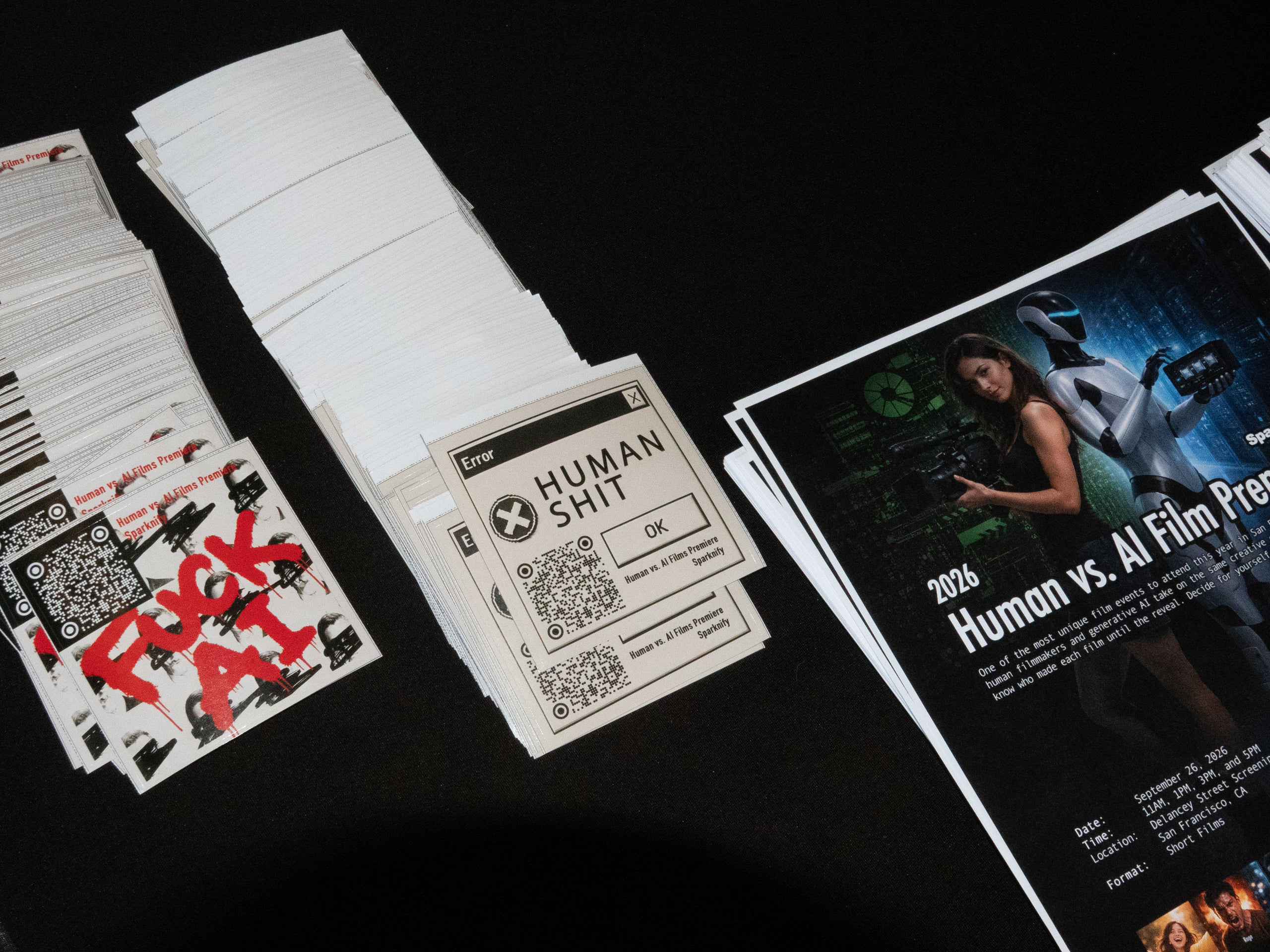
Huang is handsome and dresses simply. His black hair rises a tad before it slicks backwards. When we spoke, he stood two feet behind a Sparknify merchandise table littered with labeled tote bags, straps and provocative and contradictory stickers, some saying “Human Shit,” others, “Fuck AI.” In trying to understand why Huang, the CEO of a 10-person PR firm, is throwing an AI film festival, I was treated instead to his genesis as a “founder.”
In the beginning, Huang entered a strange field he dubbed “senior tech.”
“The least sexy space to go into,” Huang reminisced. His company developed, as he described it, a “box you connect to the TV” that feeds content to the elderly: “It’s like a streaming device for senior living facilities.” Huang got the idea because his mother “was just doing nothing”; she would “sit there and watch TV all day.” That’s where the box came in: “We will keep playing content, and you can think of it like a Facebook for grandpa, except grandpa doesn’t need to engage (with) it.”
During the COVID-19 pandemic, senior living facilities shut their doors to the public, and Huang’s business shuttered. So he pivoted; he started Sparknify, a PR firm that uses AI to generate large swaths of promotional content, flooding search results for their clients’ products.
“Another thing we do is we brainwash people,” Huang said. “For example, there’s a company called Yumi. They sell boba tea. … So they came out with a ‘love potion boba tea.’ Then we started to spread this message that if you go there — to have that famous boba tea — then you will be successful to pair up, right? So we spread this thing about how so-and-so went there to have a drink and then now they’re together forever.”
But this still fails to convey the breadth of Sparknify’s services. Huang offered the following example of Sparknify’s work, but then claimed that it was a friend of his — not Sparknify — that worked on this campaign.
“We work as lobbyists too. For example, there are people talking about how (a) bulletproof vest is too heavy. There’s a new bulletproof vest that’s thinner … so the thinner one works with lobbyists, and then they coordinate us media too … They’ll put out articles about Americans getting killed because their armor is too heavy to run from the bullets.”
“What made you want to start doing film screenings?” I wondered.
“This is like a money-losing thing for us,” Huang lamented. “Don’t go into film.”
The only reason he started the festival was for his wife, a former filmmaker.
“She’s into films, and her dream is to have a film festival. So it’s like: ‘We’re not going to have a film festival.’ And then she’s like: ‘That’s my dream.’ And I thought: ‘We’ve got AI now, so why don’t we do this?’”
After viewing submissions to the festival, Huang realized that filmmakers could use AI to imitate the cultures of other countries. He used Korean filmmakers as an example.
“The films they made, not all of them are Korean, like a story about an English child (who) grew up in England, (or) about some African kid running around in Africa growing up. There’s no way you can tell.”
He waves his hands around when talking.
“In the past, for Koreans to make a film like that, they would need to fly the entire crew out there. They’d need to have all these actors and actresses, but now they’re doing it (with AI).”
Huang’s excitement for the democratizing power of AI was shared by an audience member, Arthur, whom I spoke to earlier.
“So I’ll be biased because I created a platform for AI filmmaking,” Arthur revealed. His company, “Cinemagiq,” produces episodic content for underserved international audiences.
“I’m Armenian,” he explained. “We had a big streaming platform in Armenia, and we opened a commercial kid section.” With AI, Cinemagiq developed Armenian-language children’s media. “Armenian kids have never had Armenian animation. They watch it, they like it. It’s great.”
Huang also believes that AI content can be disseminated for dubious ends. Despite his claims to “brainwash” people, he still seems concerned with AI’s capability for emotional manipulation. Again, it begs the question: Why put this festival on?
“The way we’re doing it now is (we’re) trying to see which one can touch you better, which one can almost control emotion, right? So if the computer can control and touch you and make you think a certain way, that’s very scary. That’s very, very scary.”
I ask him whether the goal of this event is to “brainwash” people. Huang tries to put me at ease.
“No,” he says. “We actually want both sides to come and see the state of the industry, and I think it’s very important these discussions get out. Like, we’re not trying to influence anybody.”
Though he staged the festival as a competition, Huang is not choosing sides: “I don’t want this industry to be destroyed. … It’s like the horse wagon makers. When a car comes out, you know that industry’s going to be gone, right?”
Huang doesn’t seem to see filmmaking as any different a craft than car construction. In his mind, the only way for human filmmakers to avoid winding up like the “horse wagon makers” is to get bolder, a lot bolder.
He laid out his vision for the future of human film: “It’s gonna be so scary … If it’s funny stuff, it’s gonna be so weird. It’s gonna be like upside-down screens. … I bet you AI cannot come up with that.”
His favorite movie: “The one done by Jack Nicholson, ‘(The) Shining.’” He continued: “It’s like when you go out to eat nowadays, they’re so expensive now. … All these restaurants, they’re going to extremes now. They go super spicy, super sweet. And there’s a reason we go — because we get excited, right? That dopamine from eating these kinds of food. Then you go out to eat, and then you become more addicted that way. Human film is gonna be getting more and more to the extreme side.”
I’m not sure I understand his point. “Is that how you feel about ‘The Shining?’”
Huang nods, “Yeah, because, man, that was very spicy.”
Huang seems to operate in a sort of amusement park world, and thinks the future will only become more amusing. Screens are to be flipped upside down, foods reduced to their essential elements and human film, as we know it, will recede into the past, an antiquated technology, à la horse wagons.
It was the middle of the day and I was completely exhausted. As I packed up my Sparknify strap and “Human Shit” sticker, I heard the sounds of the ongoing screening, part of the “Intensity & Serenity” block. I decided to peek in.
It was an AI film, I could tell right away. A beautiful woman stood in a white kitchen; a healthy daughter joined her, and her jacked husband too. There was a sense of serenity to the image, and yet the woman expressed an unmistakable intensity. She seemed to have it all. What could be troubling her?
The woman in the film discovers an AI assistant that can grant wishes; it is essentially a genie that lives in her phone. With every wish she makes, however, there is an unexpected consequence. When she asks for a world where she can eat all she wants and never gain a pound, the AI assistant, seemingly confused, generates a world where all people can consume as much food as they want without detriment. This leads to overconsumption and global food shortages. In the end, the woman decides she prefers the world she already has: “I want nothing,” she pleads. This surprises the AI assistant, who agrees to return the world to the status quo. Everything is serene again, and an ending title card appears: “Nothing”.
When I exited the theater, I found Huang in the lobby, entertaining newcomers. I told him I’d just seen the best AI film of the day; he just smiled.