
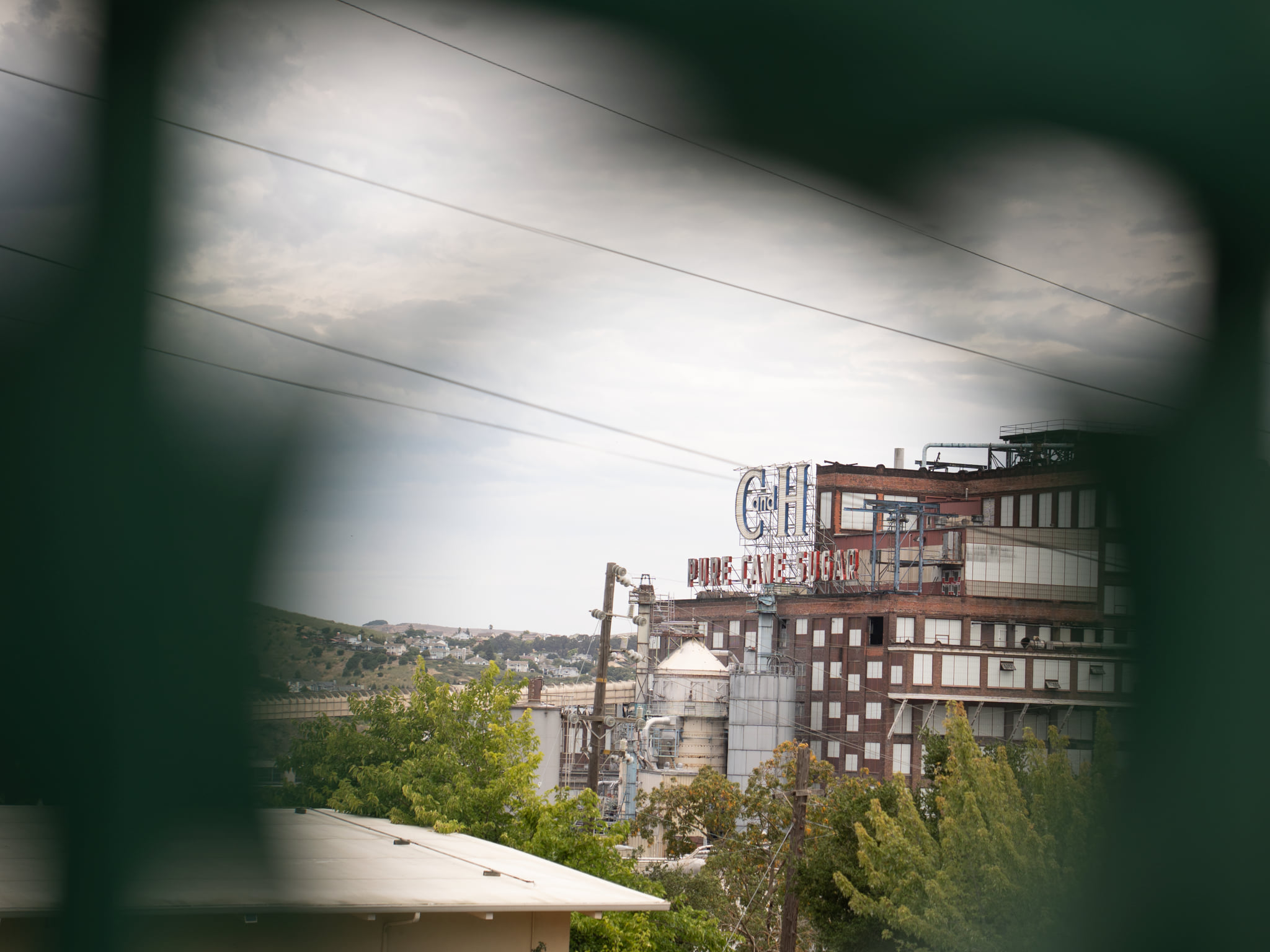
At the base of the Alfred Zampa Memorial Bridge lies the small town of Crockett. You can see it when driving north toward Sacramento from the East Bay. It’s a nest of little wooden houses, old bars and antique stores that falls in among rolling hills that descend down to the Carquinez Strait. From the hills, you can see the water, the bridge and the C&H Sugar Crockett Refinery.
Crockett is all about sugar. The town grew up around the factory when it began operations in 1883 milling flour. An honest-to-God company town — now one of the last in California — its growth was spurred when the California and Hawaiian Sugar Company began producing sugar at the factory in 1906. And its residents, less and less of whom still work for the factory, are proud of that legacy.
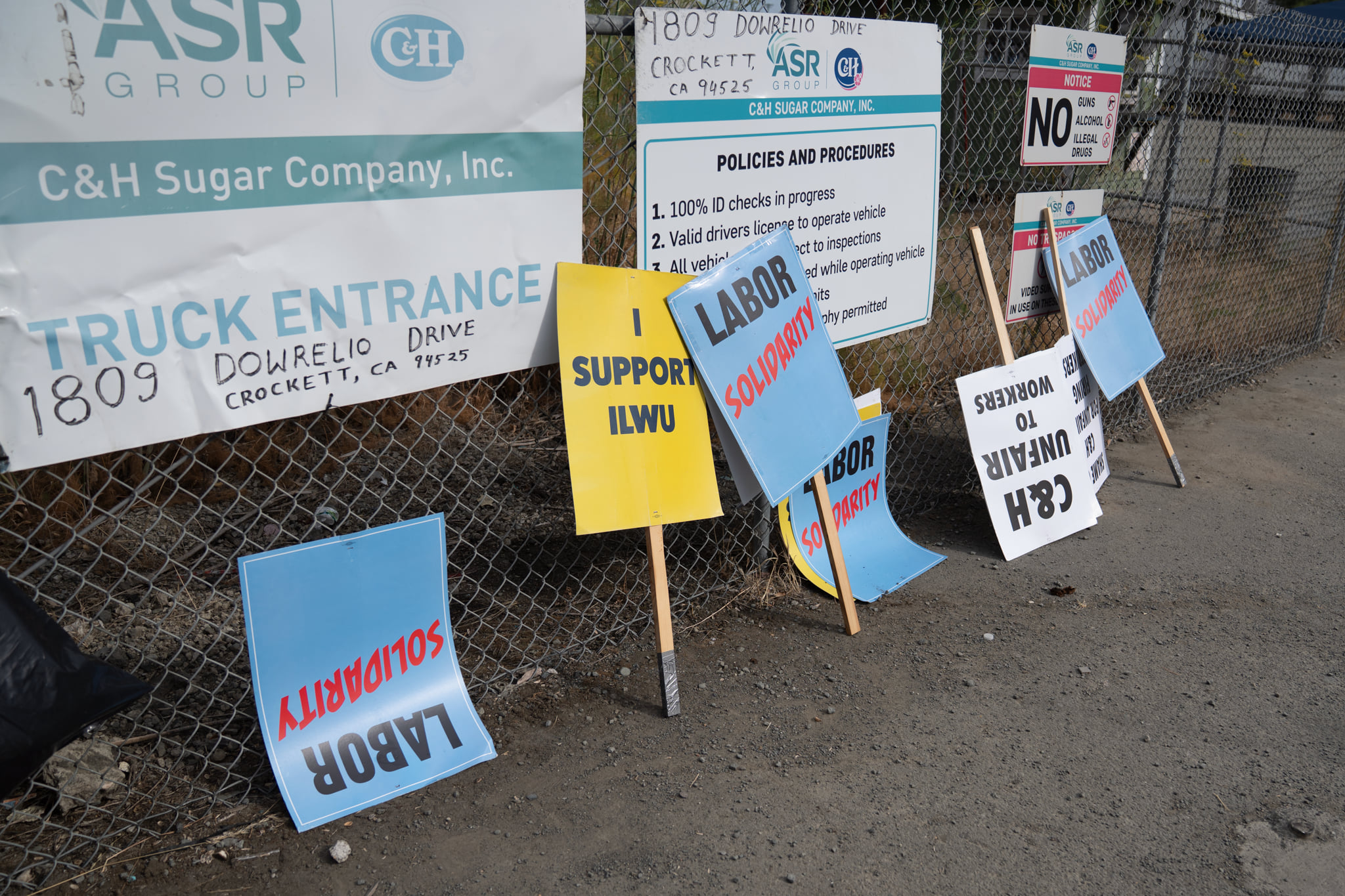
Recently, all across town in storefront windows, residential homes and in the local bar, flyers popped up: “This community supports C&H sugar workers.”
On Monday, July 13, I made the long trip up to Crockett. The bus stops right at the gates to the C&H factory. International Longshore and Warehouse Union Local 6, which represents some 100 warehouse workers inside, had been on strike for more than a month at that point. That Monday was the first day of negotiations since the picket line formed.
The strike’s origins seem almost comically simple. According to the union, C&H had proposed to cut sick time, axe retiree healthcare and change overtime rules so workers would only receive extra pay after accruing 40 hours of work in a week, opening up the door for days of grueling 12-hour shifts with no overtime pay. For its part, C&H said it has offered a 20% raise, and explains the overtime changes as helping address “chronic absenteeism.”
“We’re not asking for anything more than what we already have. We just want to stay the same and work,” said ILWU Local 6 member and 10-year crane operator Mario Rives that Monday on the picket line.
Rives was one of hundreds of union members and supporters who had all evidently made their own long treks to get out there early in the morning. Some of them would tell me they had come as far as Los Angeles and Hawaii to be there.
The day itself offered a gray morning that warmed into a blazing heat come afternoon. The union put on quite a show, gathering some 200 people around middle-aged union members, who gave speeches to a crowd of their pupils and activists, some of them young enough to be their kids. They had the Hawaiian delegation present, replete in ILWU-themed Hawaiian shirts.
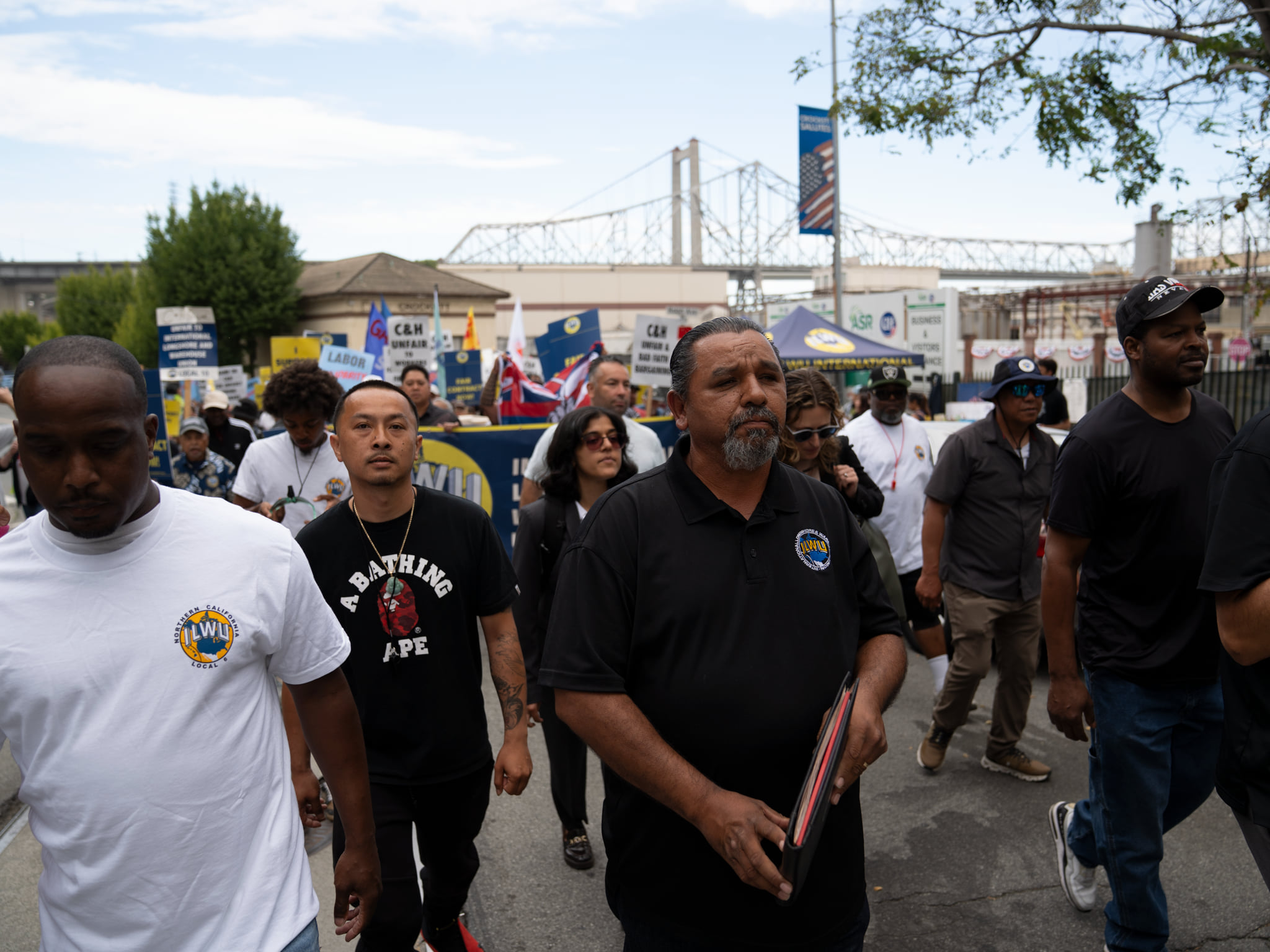
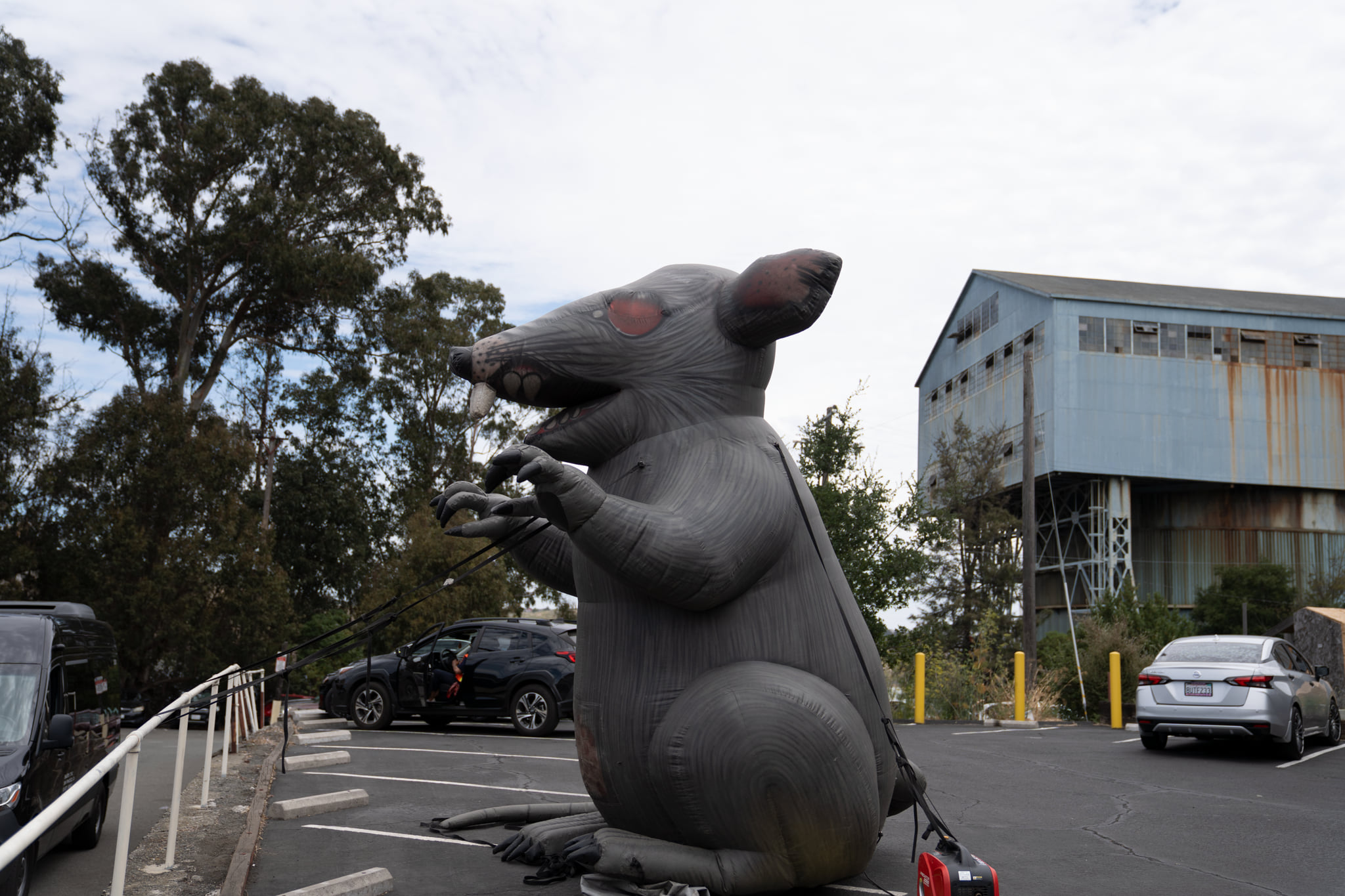
There was a great concentration of human movement. Union members and their supporters brought out a brass band in bright pink shirts, marched faithfully in circles chanting against the chain-link fences erected by C&H and blew up a giant inflatable rat over the parking lot. Behind the fence, trucks paced back and forth across the yard.
From within that factory, C&H responded in form. Workers spoke of hired strikebreakers — scabs — crossing the picket line. C&H also hired security guards to hold camcorders.
For a while, the company also paid to keep a ship loaded with sugar, the Tai Herald, docked behind the factory, waiting for workers to unload it. C&H also had to contend with union members who had organized to systematically block and delay trucks coming in and out of the unloading yard.
Union members and supporters marched back and forth in front of the entrance to the truck yard, letting one truck in or out of the yard every three minutes. At one point, 18-wheelers had piled up a dozen deep and stretched up the off-ramp from the highway.
The only people from C&H I spoke to that day were its fixers. There were two: one thin, tall, hawkish and bald in a blue golf polo, the other large and stout in a black T-shirt.
I saw them patrolling the picket line. I tried asking for their names; they wouldn’t say. Later, I asked what their jobs were at C&H. “We fix problems,” the large one offered. I think he was wearing a Rolex.
The thin one left and went down the hill and started recording people on the picket line. I asked him why he was recording.
“I’m just a bystander. I’m reporting. Channel 6,” he said. “Is there a Channel 6 here?” I told him I didn’t think so.
Most of the people I spoke to that day seemed optimistic, maybe a little delusional. They had been out of work for weeks — one union member, Manny Loera, told me he’d had to reduce his daughter’s time in preschool, that he worried about his mortgage and that “it causes strain on marriages.”
Bills were surely piling up for the union’s members. Yet Loera still believed that this union of working-class factory workers could stay out for six months.
ILWU Local 10, representing dockworkers across the Bay, had walked out with them, even briefly shutting down the port of Oakland one day; half a dozen Bay Area organizations had turned up to the picket line.
Throughout the day, the crowd chanted an old reprieve: “The people, united, will never be defeated!”
“There’s going to become a point where whoever the bean counters are, are going to say, ‘Hey, we’re losing money every day on the product, we’re not doing what we need to be doing, so we’ve got to give a little bit and give them a little bit,’” Rives told me.
Cesar Garibay, a member of ILWU Local 6’s bargaining team, had spoken with me earlier in the day. He hadn’t offered any specifics about bargaining, strategy or if they thought the company might budge.
“With all the money they’re spending, I hope it got their attention,” he said.
C&H Sugar never answered my inquiries into how much money it had spent on keeping the factory running and its workers outside of it. Just keeping the ship docked, however, could have cost the company tens of thousands of dollars every day.
C&H has defended the necessity of the cuts in its proposed contract as “a matter of survival.” Hitesh Modgil, general manager of the factory, said, “The pressures are real and growing. California recently witnessed the closure of its last sugar beet processing plant, and other sugar facilities across the country continue to consolidate or shut down.”
While I was speaking with ILWU Local 10 members at the truck line, some union members told me I should talk to their business agent, Frank Gaskin.
“This is fucked up. Fuck C&H. It’s blood sugar,” was all he offered.
There is blood in the history of Crockett — a brief spat in 1938 saw a bloody feud between two unions that became known as the “Sugar War.” After that, however, the history of Crockett becomes less certain. The Crockett Museum, run by volunteers at the factory’s old train depot, is only open for four hours on the first and third Wednesday and Saturday of each month. It offers relatively few words on labor in this company town.
It does offer free C&H sugar recipe booklets.
The curator of the ILWU’s oral history collection, who wrote a book about ILWU Local 6, does not remember the last time the union went on strike, nor does Barbara Denton, who has lived in Crockett for more than 50 years and also wrote a book on the history of labor in Crockett.
Crockett’s history has seemingly vanished. Nobody, in this town built around industry and labor, knows anything about its labor history. What remains is the town, its people and the enduring factory. According to the museum, the town of Crockett, officially laid out in 1881, sprang up with the railroads. The factory followed in 1883, then operating as Starr Flour Mill. In 1897, the mill began to reconfigure toward sugar. The next year, in late April, it produced its first batch of white sugar and was acquired by C&H shortly thereafter.
It has, of course, continued to produce sugar. It has done so for more than a century.
According to one of the museum volunteers, Les Bellecci, and Denton, C&H treated the town with mostly perfect benevolence. Denton and Bellecci both told some version of the same story regarding when the company’s first president, George Rolph, moved into town, at the time consisting of the factory and a number of bars for its workers to drink in. In Bellecci’s telling, Rolph said to himself, “If I got to live in this godforsaken place, I want to be comfortable and I want my people to be comfortable.”
At some point, that relationship began to sour. Maybe it was as early as the ’60s, maybe not. It certainly changed by 2005, the year the factory was acquired by American Sugar Refining — the world’s largest sugar refining conglomerate. According to the union, ASR pocketed $1.6 billion last year.
Denton, who liked to talk about her perfect childhood in Crockett, has a simple way of putting it: “What’s playing out in Crockett is what’s playing out nationally,” she said. Denton’s an old lady in kooky red sunglasses who sounds deeply tired. “Everything’s outsourced. There’s not a lot of skin in the game.”
Union members I spoke to put it another way. They no longer lived in Crockett, even if their families once did. Their fathers could provide for a family of five on a C&H salary. They are struggling to make ends meet as the cost of living continues to rise.
“Every year there’s been a little bit of give and take, but nothing to the extent of how critical some of these concessions are,” Loera told me. All the old bonds have been broken.
I spoke with a local man named Joe Rose a couple of times during my visits to Crockett. Once, he told me COVID-19 was caused by 5G cell towers. We were sitting on a bench and Rose had just put away a joint.
“They honor the money. Money is god,” Rose said at the picket line. C&H, maybe all big corporations, had gotten so swollen, so fat with money, that they could do this. Still, Rose is a cheery guy. People, he said, are like ants. If you step on one, the others will climb onto your boot and bite you.
So the strike wore on, sometimes flailingly. There were altercations with scabs, 10 arrests and alleged collisions with vehicles on the picket line.
C&H, in an unattributed statement, described the conflict as “unlawful and dangerous activity” that threatened the company and its workers. It maintained that it had “worked tirelessly to resolve the labor dispute.”
About a week later, the strike, then six weeks running, came to a quiet close.
The union had reached a deal with C&H — return to work for 60 days and keep negotiating. No contract was on the table.
“Management is happy, it’s less stressful for their shoulders, doing the work,” Garibay told me in a phone interview. “They’re all happy that these guys are back at work.”
I asked Garibay if he thought the union might have lost leverage in negotiating by entering this deal. He said no.
That was Aug. 10 and, sure enough, one month later, word came that the union and C&H had struck a tentative agreement. The union narrowly approved it the following Monday.
It turns out that the agreement stripped the union of the eight-hour workday. ILWU Local 6 workers would now only incur overtime pay after 10 hours of labor. They retained the pay raise C&H had offered, albeit offset by decreased overtime. Existing retirees retained their healthcare benefits, but a handful of union members on the verge of retirement lost their coverage.
The union lost ground everywhere. One member of a Democratic Socialists of America group chat that was formed to support the strike called the vote a ratification of surrender.
“There is no guarantee that the ILWU will win if we fight, but if we don’t we surely lose,” he wrote.
His message got a little attention, but not much. People agreed it looked like a bad deal. One person said it was easy to say they should fight, “but there has to actually be the ability to make it happen.” The union had, of course, fought. And it had, in many ways, lost. The group chat seems to have moved on — a few of its members have taken an interest in the SF Opera strike.
In September, American Sugar Refining released a blog article celebrating 120 years of “Community Partnership in Crockett.”
“As our C&H Sugar Crockett Refinery celebrates 120 years in Crockett, California, we remain proud of our long history of investing in the community,” the company wrote. That swollen bank of bricks, the refinery, is celebrating. Does it dance? Does it sing? Does it shout and cheer with joy?
I went back to Crockett the day workers returned. It was scorching hot. The gates to the C&H factory hung wide open. Trucks moved inside the yard. Across the street, in the window of a little boutique, still hung a little flyer: “We support the ILWU.”