
Fiona’s friends knew when she had a soda she’d pull the tab off the top. Maybe she’d play with it. Maybe she’d sink it to the bottom of the can. Maybe she’d keep it. Or when she went to the movies, she’d fidget with the ticket. She’d fold it up. She’d tear it into strips. She’d pocket it. Maybe for a scrapbook, a memory box. People leave lots of detritus behind. No one thinks about where it goes.
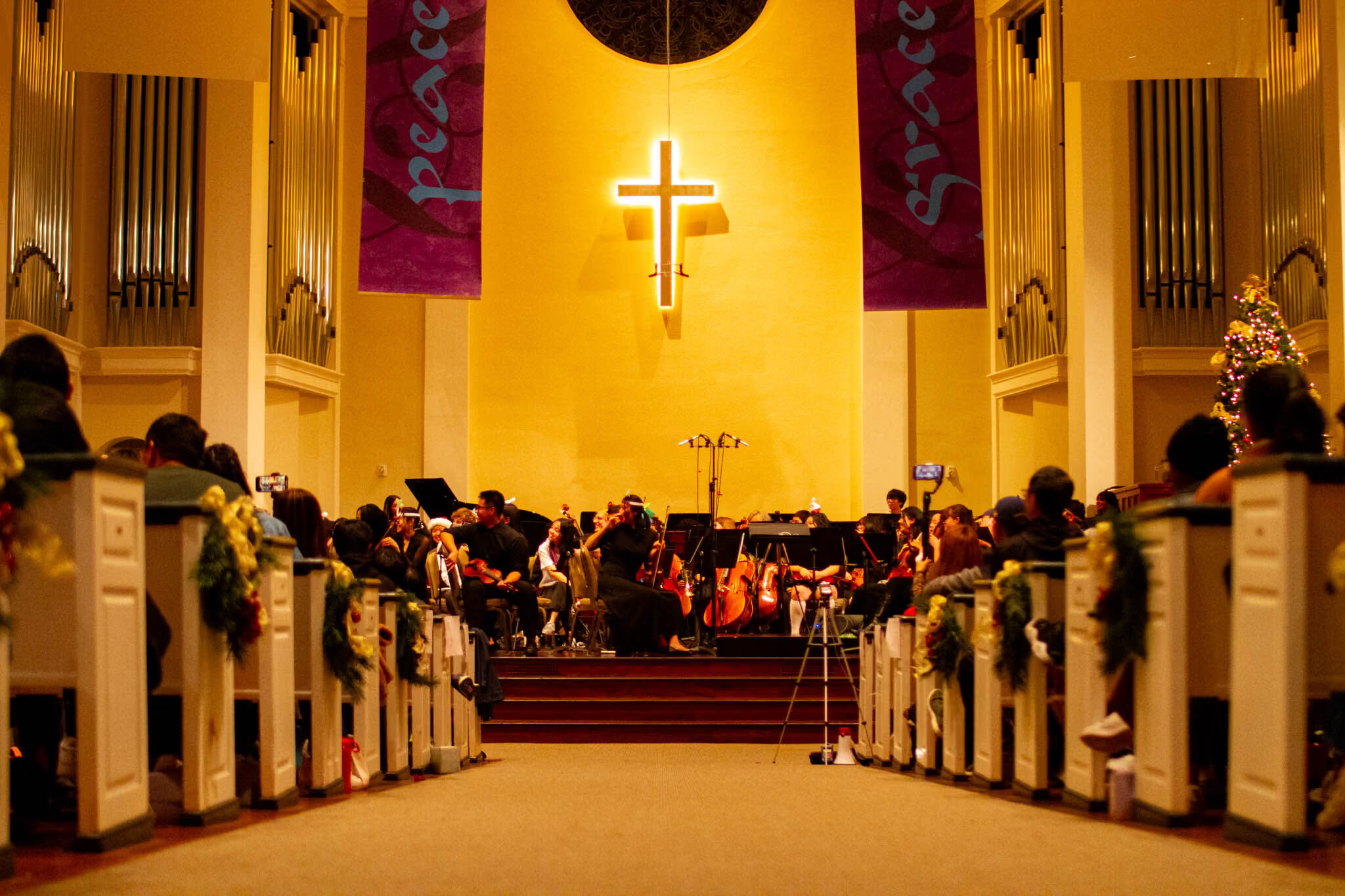
13 years of Catholic school had not given Fiona much. She knew a couple of hymns. She had “Our Father” memorized. But mostly her time spent in daily mass was emptied of any true revelation. She daydreamed, imagining the stained glass windows in biblical proportion floating on top of the priest’s service. Her foremothers and forefathers, Bethlehem, the Last Supper — all as spectres overlaid on the wooden altar, coloring the mahogany with the silver spray of ghosts.
Sometimes she’d imagine the chapel caving in. The force of the thought was so strong she worried she might think it into existence, that G-d would hear her and only her, and misfortune would befall everyone because he tuned into the wrong frequency. The girls would fling themselves out of the pews as the ceiling beams swung down and crushed them. Rolled skirts would ride up; the nuns wouldn’t be allowed to care. Everyone would be free from that hour a day where they were forced to pretend to care about their salvation, as if that hour of the day absolved them from everything, as if they wouldn’t go back to gossiping in the hallways. What might it be like to free everyone from the charade of being nice and devout, even if that spelled disaster?
Fiona did like the saints, though. They felt like a pantheon of her own. It embarrassed Fiona that she felt an affinity for Joan of Arc, but it didn’t stop her from researching how to make chain mail. When she lost something, she always thought of St. Anthony. And when she ran a red light, there was St. Christopher.
The miracles made sense to her, too. It took just three miracles to be canonized. Levitation. Healing bodies. Stigmata, the wounds of crucifixion felt and embodied. Revivification. Surviving poison. Droughts cured. Villages converted. Lives sacrificed. It was a neat configuration, ordered and without doubts. If you are a miracle, you will be venerated. If you ask for something, you receive.
These were the thoughts she shared in Bible study. But the thing she loved most about Saints was their relics. Gilded cages filled with bloodied rags. Clothes long ago discarded. Even the third-tier relics, simply the objects that a saint once touched, were enough for G-d’s intercession if your skin grazed their surface. He could heal you with just a touch of your rosary to a saint’s handkerchief. That was all it took to summon him.
Fiona didn’t want to believe that relics had that much power. But belief wasn’t something she had much control over. If the thought was there, it wasn’t her fault. She’d learned about the relics young — maybe at age 8 or 9. She went home that day from school and looked at her room. She saw some books, some toys. If a divine revelation was going to come to her, she needed something to put in a glass case on a cathedral wall. She started collecting things.
She knew it was weird. But the weirder it felt, the more she couldn’t stop doing it. An object would be in her hands. She would feel a sort of lightning strike through the back of her eyes and she’d know, yes, she needed this one. Yes, that one.
The McDonalds straw. An arc of a fingernail torn off. A burnt candle end. Bottle caps. Dirty Tupperware. Old earbuds covered in wax. String cheese wrappers. Valentines. Emptied-out pens. Seashells. Dried-up flowers. Rain boots she’d outgrown. A rat skeleton. An owl pellet. A scab.
You weren’t supposed to want to be a saint. She didn’t even really want to be a saint. The desire to collect was like a safeguard. In the case of divine intercession, she would come prepared. It was worse than wanting to be a saint, more vain and illogical. The kind of thing that made people doubt you were of a sound mind.
When she tried to stop collecting, an image of her funeral would flash before her. She’d try to shake it off, but she couldn’t. She rattled her head. Tried to cough it out like a sickness. Blinked once, twice, three times. The image remained, and it would reveal itself to her, how she imagined G-d revealed himself to the generations of Catholics before her. Sometimes he meant she would die if she stopped collecting. Sometimes he meant if she stopped, she’d have nothing to show for her life. Sometimes G-d started a chaos in her that she didn’t know how to quell. It lasted until she found something to collect. Divorced from any hopes of goodness, her relics were how she carried on.
She kept things quietly. She gathered sentimental clothes she grew out of. Old bandages, anything with traces of blood, all hid meticulously. Fiona was prepared to be found out or martyred at any time, whatever came first.
As the years wore on, Fiona didn’t feel pious or uncomplainingly suffering. She mostly felt pathetic. G-d hadn’t spoken to her and she knew he never would. But she thought he might. As she got to ninth grade, it seemed to her like this whole Catholicism thing was a scam to make money and warn women of the “evils” of birth control. As her faith wavered, her daily life sucked up any last vestiges of her superstition in its quotidien unremarkableness. Her carefully preserved collection rotted away in her bedroom. Her repressed hopes of sainthood became imperceptible, save for a trail of ants and the smell of a putrescent corpse coming from her closet she’d long since gotten used to. When her mom finally commented on it, she said she’d thrown up and spent the next day reorganizing her collection into sandwich bags and airtight containers.
It was her senior year and she was walking through her neighborhood, stepping on the purple flowers littered across the sidewalks and smearing them across the pavement absentmindedly. She looked down at her feet, but saw her hands. She stopped still. There was blood. She had not injured herself, but the pain was unbearable.
She rushed back home, pushing open her door with her elbows, dripping blood. She sat down on her bed and peeked down at her hands. The wounds looked so familiar, but she didn’t know why. The pain got worse and worse and worse until she saw a flash of metal nails going through her palms. They were stigmata. Her first saint’s miracle. She felt a breath of calm. She rushed to her desk drawer, pulled out her phone and took a photo of her hands, each one individually. She went into her bathroom, found a hand towel, and tried to stop the bleeding. But she couldn’t stop it. These would be her rags, encased in gold, the end of her collection. The pain was searing through her. A nausea bubbled up so strong she started to gag. She curled onto the cool tiled floor, rocking back and forth. Consciousness lost its grip on her.
Fiona woke up with her mother standing above her. She flung her hands out, but her mother just stared at her expectantly.
“I have the wounds of stigmata,” she stuttered out.
“Fiona, your hands are all clean. I’m not sure what you’re talking about,” her mother replied.
“I knew this was going to happen. And it did.”
Her mother just tsked at her while Fiona rushed to pick up her phone and to show her the photos. She flicked through the library until she found them. In the photos, her hands were white. Not a drop of blood.
“Mom, I swear I wouldn’t lie. You know I wouldn’t,” Fiona pleaded.
“I know, Fiona. You’re such a saint,” her mother said as she reached down to hug her.
Fiona laughed. It was funnier than any joke anyone had ever told. Her mother didn’t even know why. She laughed into her mom’s tightly wound arms until she signaled to be let go. She lay back on the tile floor when her giggles subsided.
“I know you never would never lie, honey. Probably just a bad dream.”
Hair ties, hair clips, hair combs. Used tampons, toothbrushes, and bandages. Shoelaces, eyelash curlers, lip gloss, fingernails. Stuffed animals, notebooks, pens emptied out of ink. Sewing needles, disposable razors, scissors. Teeth hidden from the tooth fairy and tiny braids clipped out of her head. Empty plastic bags that once held peanut butter and jelly lunches. Chewed gum. Old running shoes. Socks. Saint’s rags.
Years of detritus disproven in one afternoon, but relics are not worth anything for a fake saint.