“Politics has largely become a spectator sport, run by professionals with disdain for ordinary people.” — Harry Boyte, senior scholar in public work philosophy, Augsburg University
“The future of progressive politics in America is in the hands of a generation of young people who are being burned out and exploited.” — Dana Fisher, director of the Center for Environment, Community, & Equity at American University
When CALPIRG’s hiring team approached me in the spring of my freshman year, I was as bright-eyed and enthusiastic about the work as anyone. Sure, I’d been annoyed by the constant haranguing for a “pledge,” but I figured that working for the organization was an easy way to make a measurable difference as a progressive, engaged person.
For the uninitiated, CALPIRG, or the California Public Interest Research Group, works to promote environmental and other “public interest” legislation, describing itself as “an advocate for consumers.”
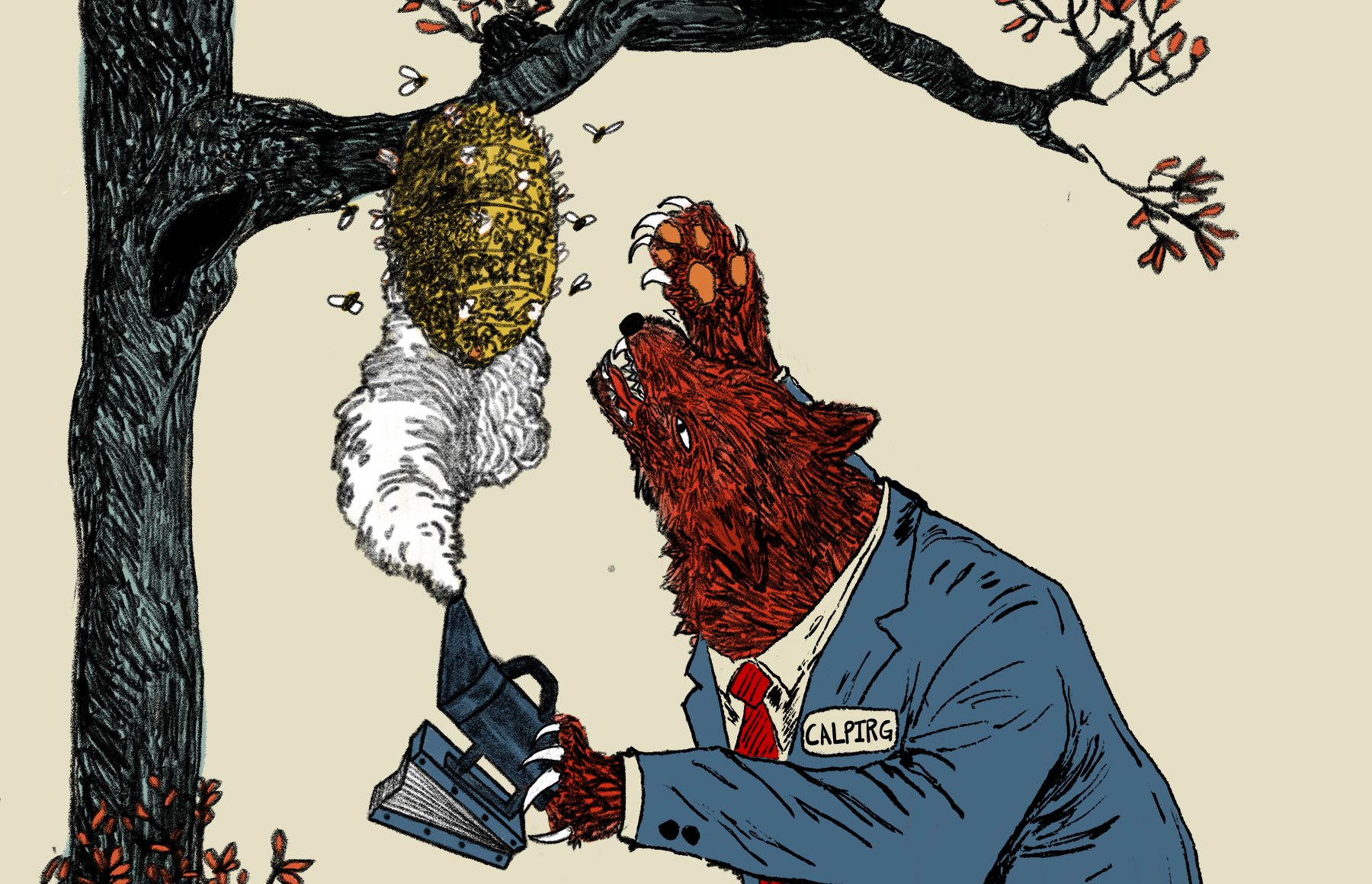
CALPIRG Students, those people in the bee costumes on campus earlier this semester, are legally distinct from the larger organization CALPIRG, supporting its work largely through $10 semesterly donations from students. They pursue this mission largely by stopping students on their way to class. CALPIRG itself is an organization under the Public Interest Network umbrella, funded primarily through canvassing from its affiliate, the Fund for the Public Interest.
This structure is so Byzantine that an ex-canvasser I spoke to, who requested anonymity for fear of retaliation, reported they didn’t know who their employer technically was while working for the summer canvas.
I joined CALPIRG as a summer canvasser in 2023, though I was legally employed by the Fund. Far from the fulfilling, engaging job I’d imagined, my time at the organization left me feeling stung.
I came to find that the organization is not only ineffective but actually harmful for progressive organizing.
In 2019, HuffPost described the Fund as a “liberal sweatshop” that burns and churns through its employees. This was on full display during my time at CALPIRG. By my second week on the job, a massive proportion of the roughly 30-canvasser team I joined had either quit or been fired. In their place were a veritable army of new recruits, hired under the same pretense of “making an impact” that had drawn me to the organization in April.
Another former CALPIRG canvasser, who requested anonymity citing the same concerns, echoed this sentiment. “I started out with a cohort, and at the two-week mark, I did not recognize a majority of the people in the room. … Tthat happened every two to three weeks,” they said.
In her ethnographic study of the Fund, sociologist Dana Fisher reported that the average length of employment for a canvasser at Fund affiliates was two weeks. Canvassers routinely quit, citing long hours, low pay and physical and mental strain caused by the work.
Their experience was not unique. The Fund has a 2.0 star rating on Glassdoor, with hundreds of employees alleging brutal working conditions. Moreover, the organization has a labor record that would be troubling for an Amazon warehouse, much less a youth-oriented progressive political organization. In 2009, it settled a $2 million labor lawsuit with its former employees in Los Angeles. In 2014, it settled another lawsuit in which an employee alleged they had been fired for attempting to start a union. In 2002, 2005 and 2019, it shuttered summer canvass offices shortly after NLRB complaints or unionization efforts.
Some would argue that these working conditions are simply the cost of an effective progressive political organization. Canvassers could always get a different job and political work is difficult.
CALPIRG State Director Jenn Engstrom said the quick turnover is natural because canvassing is not for everyone. She added that it is a byproduct of the sheer number of people they “invite to try the experience.”
“We don’t see that as an indication of a problem,” Fund National Director Emily Reid wrote in an email. “There are lots of ways to make a difference and important roles in the world, and they're not all going to be right for everyone.”
This model fails, however, at building lasting political power. As Fisher argues, burning through young progressives results in mass disengagement from politics, with only a small fraction of ex-canvassers returning to politics a year after working for the Fund. The two Fund canvassers I spoke to said they felt “disillusioned with politics by the end of the summer,” and “100 times more mindful and critical of nonprofit organizations.”
Organizations canvassing through the Fund have pointed to mass growth in membership but have been unable to summon this membership for meaningful political actions. Resultingly, they have been significantly politically marginalized. The CALPIRG representatives I spoke to recently celebrated, as a major victory, the banning of over-the-counter sales, for residential and lawn use, of a single class of pesticides that is mostly used in non-consumer seed coatings.
So much for saving the bees.
This outsourced, disinterested model of canvassing has also failed, to a shocking degree, at creating any kind of lasting political infrastructure necessary to build a movement. Students who sign a CALPIRG donation pledge may care enough about the organization and its work to donate money, but a vast majority of them would not donate meaningful time or energy to its actual events. As political scientist Robert Putnam put it, “mailing list” organizations such as CALPIRG “are not really associations in which members meet each other” and can thus organize and meaningfully pressure lawmakers. The ex-canvassers I talked to agreed. When asked if anyone they spoke to seemed likely to get involved beyond simply giving money to the organization, they told me, “I’d guess almost none.” Rather, donors hurriedly give a small amount to a canvasser at their door or on their campus, receive junk mail they will not read and forget about the organization altogether.
Still, the canvass attracts a large number of donations. CALPIRG reported more than $12.8 million in assets in 2017, and the Fund reported more than $15 million in revenue in 2024. Engstrom told me that “most of the resources go toward the staff … there are limited operating costs.” In terms of the staff’s day-to-day, she told me much of their funding goes toward their advocacy team, which collects petitions, holds press conferences and speaks to legislators.
Political scientists Martin Gilens and Benjamin Page found that attempting to out-lobby major corporate interests such as Amazon and pesticide lobbies,two of CALPIRG’s recent targets, is a manifestly hopeless political strategy. Nevertheless, Fund groups remain wedded to institutional rather than direct action approaches. If CALPIRG really did exert any kind of meaningful political influence over its members, we may expect it to routinely mobilize its donors for demonstrations — or at least align itself with people who do.
Engstrom, explaining why CALPIRG tends to avoid such tactics, told me it first considers “softer” tactics such as getting an editorial in the Los AngelesTimes before considering escalating to a protest.
“Those types of actions might annoy (political leaders) more than convince them to take action,” Engstrom said.
In this context, CALPIRG’s donors outsource politics rather than participate in them. Moral values are commodities to be bought and sold: If you care about the climate, all you need to do is make one donation and continue business as usual, with no need for the cumbersome and costly business of organizing for real political change. After all, we wouldn’t want to go out of our way to annoy the legislators watching idly as corporations set the planet alight.
The cost is twofold. First, there is the brutal reality of labor exploitation on behalf of canvassers. Within this ethical market, canvassers themselves function as interchangeable parts that can be juiced for all of their organizational energy at the behest of donors and groups. They are an unfortunate byproduct of the commodity being generated for a wealthy donor class: namely, the need to feel that a difference is being made.
Second, these groups serve as an exhaust pipe for the tragic feeling that the status quo is harming other people. By donating to groups such as CALPIRG, donors satisfy their ethical urge for change without actually contributing to it. The urgency that would otherwise build around any number of political issues diffuses instead, with a broad smattering of donations conceptualized as a suitable replacement for political engagement.
In this sense, ideology becomes separated from action: All the ambient negative sentiment that accompanies exploitation can be wished away with the promise that someone else is fixing the problem, and donors can rest easily without interrogating the more structural causes of this political malaise. It puts off broader questions surrounding economic and political organization in favor of a brand of reform that is piecemeal, outsourced and moralizing.
The rise of fascism in the U.S. presents a more immediate problem. Under President Donald Trump’s administration, we may expect groups committed to guaranteeing a voice and space for the public to be organized radically against the Republican Party. Other organizational problems aside, civic groups could represent a powerful source of opposition to authoritarianism. Nevertheless, CALPIRG’s official student website for UC Berkeley continues to proclaim its nonpartisanship with smiling students in front of balloons representing the Democratic and Republican parties.
This is curious. One of these parties is cementing a ruthless authoritarian regime committed to invasions of civil liberties, sale of public lands and other policies that are not in the public interest. I asked Engstrom how much longer a group ostensibly committed to fighting for the little guy could remain neutral:
“Forever.”